The idea of what the zone game could be like arrived through progressive interations of understanding what a computer game concept should not be. I felt that it could be one which integrates into the conscious experience of the system aspects of ‘pervasive’ gaming, or some form of computer-augmented, physically-robust gameplay in order to engage the physically situated properties of urban and suburban spaces in ways that conventional console and computer-based games do not. I knew then that such games did not exist because I tried and was not able to purchase “pervasive” computer gaming systems in any market in the world at the time that I was developing my thesis. Such games are within the purview of research and development, and so merit consideration as a valid trajectory of study for the development of favourable user experience designs in the domain of digital interactivity. The zone game is both inspired by and a response to the simple brutality of zoned-industrial neighbourhoods which present low interest to children for free-play activities in the outdoors.
“Mobile/pervasive games are going to change the way that we view games as being static in space and localized in time.”
-Regan Mandryk, PhD School of Computer Science, Simon Fraser University, Edge Lab
“In the precomputer age, games were designed and played out in the physical world with the use of real-world properties, such as physical objects, our sense of space, and spatial relations. Interactions in precomputer games consisted of two elements: human to physical-world interaction and human-to-human interaction. Nowadays, computer games have become a dominating form of entertainment due to their higher level of attractiveness to game players.”
-Pervasive Games: Bringing Computer Entertainment Back to the Real World
C. Magerkurth et al. ACM Computers in Entertainment,Vol. 3, No. 3, July 2005
Is it possible for play activities which take place in the physical world of the zoned industrial city to emulate the qualities one encounters in a virtual game? How can these areas which present low interest to children for free-play activities be reframed as worlds holding potential for play which augments the bifurcation of nature into those spaces which have been allocated to human use and those which have not? The intent is for the design to communicate how the need for an electronic game which allows for computer-augmented play is really about the need for play irrespective of the computer-augmented modalities one attempts to tack onto a thing done by human children with even the most modest of means. Play is for childhood, and not for the leveraging of computers onto a child’s ultimate experiences and memories of his or her childhood. This work was a creative exercise in conceptualization towards innovation in a domain for which it is uncalled for, but in order to spell out in terms more favourable to the interactants involved a design specification which enables ranging and other forms of exploratory apprehension of zoned industrial neighbourhoods by the children that inhabit them, it becomes necessary to state both the obvious and seemingly impossible in order to connect the nodes between the two. By imagining them as more than the malaproprism of ‘hives’ of industry, it is a forcing of conjecture to the effect that even though there’s nothing better to be had now in the realm of games which could potentially engage the whole child individual in a situated environment which includes nature and risk in quasi-controlled exposure situations, it is nonetheless imperative that the types of systems now in use are improved in the future to further attend to the physical activities and stressors which are determinants of children’s optimal health and development, in any type of neighborhood or urban planning schema.
I would suggest that it’s improbable that a computer-augmented game could either capture or though its various input and display modes, express the essence of an unstructured play experience in the real world. I further suggest that the development of computer games in a manner even only approximately contrary to play experiences involving the physicality, contingency and singularly, experientially authentic risk of the physical world is a grave mistake if we presume from the outset that the former can ever stand as a substitute for the latter. I am a keen proponent of forcing children out of the house, but only to the extent that the gravest risks involved can be mitigated. In order to understand the risk involved in such an enterprise, one would have to contrast the risks to children involved in interactions with the world and other people outside of the home with the risks attendent to sendentary play involving only computer-based media. I was growing up just as this genie was escaping the bottle, so I can remember the two worlds as distinct entities. There are more children now than there were back then for whom such distinctions would seem less obvious, being as they are ‘natives’ in the age during which the profligacy of digital technologies is approaching totalism, in that everything smart which once had an aura of newness is now ubiquitous. I would surmise some degree of success in even only answering 5W type inquiries as to the expectations and presuppositions which engage human beings as they enter into communication and cognition feedback loops with their dreaming machines. Could we have gone back and selectively altered the paths and communions we entered into with this technology as we brought it into our homes and our lives, what would have done different knowing then what we know now?
The intent of this project was to develop the concept for a physically distributed virtual game that employs and strengthens the social connections between children by using the physical properties of the play space to stimulate their unstructured play activities. By strengthening the social connections between children through copresence in virtual and physical space, the integration of play activities in any given (sub)urban environment with networked tools can utilize the environment of the city as a staging ground for computer augmented play whilst not detracting from the core elements of physicality, contingency and authenticity. It is within this conceptual framework that the design of the user experience could be expanded into a physical prototyping phase when the initial goals of specifying the determinants of the potential value for the user are achieved. I feel that the ideal role for the virtual software environment is in supporting the emergence of collaborative, competititve and expressive actions imparted by the users on the implementation of the software in the dualistic sense of both the physical and informational relationships shared by the game’s child participants. If the unique knowledge that children have of their play spaces is to impart meaning in a design sense and aid in the conceptualization of such a game in the capacities of art direction, system behaviour and goals/penalties, the imperative to develop a design concept which is more than the sum of its parts must subordinate the graphical display and audio projection elements to the physicality of the experience, which is to say that the game must in a very real sense render its imaginal elements in a manner which ensures that any patterns of consciousness which derive from the game environment are ‘anchored’ to a physically extant geographical feature be it a building, park or ravine. In this way the experience might challenge the conceit that sendentary gameplay in an enclosed space is necessarily something we as consumers of these types of media have grown accustomed to precisely because the world is dangerous.
The sense of the world in any one of North America’s cities is that each of them are in their own way a simmering cauldron of risk, wherein chaos occasionally erupts, breaching the seemingness of peace and predictability and if as even only nominally rational participants in this system human beings determine that on the balance of probabilities it very definitely is unsafe to allow their children to wander away from home unsupervised, then it would make sense to keep their children inside. It would be a mistake to keep them in however in thinking that it would be better for them to stay indoors because it might be unsafe outside the home. There are a good deal of things in the world that are unsafe and if each of us were to take every precaution so as to avoid danger in all of it forms, the world wouldn’t be a world anymore, based on the correctness of the statement that the world is a simmering cauldron of risk, wherein chaos occassionally erupts, breaching the seemingness of peace and predictability.
games as social constructs
Virtual games which adapt a synchronous, collaborative style of interaction have been found to stimulate socially rewarding gameplay, especially in group contexts where several individuals engage with one another face to face. This is referred to by Lev Manovich in Spatial Computerization and Film Language (p50.) In any situation depicted via spatial narrative, events in either the actual world or any simulated world are observed as if from multiple perspectives. In the instant that some given spatial narrative is communicated and understood by multiple interactants in the narrative system be it a computer game, play or film experience, the way in which the meaning of the story is being conveyed is also the way in which meaningful social interactions and cooperative forms of play in physical space generate a cohesive, consensus sense that such physically embodied and co-located experiences are meaningful to human beings. The meaning emerges precisely because shared experiences have long been the antecedents to solitary, computer-generated interactive gaming experiences. It seems even less important that electronic interactive media and games first trickled onto consumer markets with dual player presets as an adjunct to ensuring the presence of some social component to the experience, than the fact that early on the devices weren’t designed to be connected and networked. Further, that these systems weren’t designed to be connected and networked seems an inconsequential design deficiency when considering how few of these systems were designed for portability, and instead were ensconced with their users in basement warrens or other enclosed spaces, microelectronics under plastic chassis’ sheltered from the world and elements.
Networked computers are one of the means by which the formation of one particular form of spatial narrative is possible. Allocate more processing power to increase throughput and it follows to reason that an amplified perspicacious to the player’s experience should undergo change in comovement with the twists and turns of some particular game or storyworld narrative. It is possible that by having others co-present in the game’s in-play areas that there would emerge an emotional gravity to the experience, the particularly attractive qualities of which are impossible to achieve in any other group-enabled game context. It follows to reason that for interactive computer games where activities and intelligence are distributed over virtual structures in cyberspace, there cannot fully emerge the awareness and insight as experienced by individual participants when the latter are situated in a physically co-located commons. Practical insight into this distinction can be gained by contrasting the experience of simulated combat in a paintball arena with the digitial counterpart in an online first-person shooter. The former is clearly the more exhilerating of the two except that it draws blood, with the user engaging in the game despite the risk of being dealt the painful physical consequences of inattention, dyscoordination or poor judgement. The physical world in all of its elements and phases, outside of the audiovisual feedback regimes of computers and gaming consoles, the things of the world, were the essential elements to any experience I was going to set about conceptualizing.
I wondered that if each user were provided access to a visual representation of what every other user is able to see, would the situation engender any odd feelings on the part of the individual user that they themselves are part of a larger social construct? I would argue that the temporary social construct of a game would render such an awareness extant though the physical, psychological and emotional influences of the unified activities deriving from the engagement of the play group with the software implementation, but only by being plugged into the terrain of a zoned industrial city scape could the physical parameters of interaction be reconsidered. Could the presence of interactants together in space affect the group dynamic in a way which results in the experience feeling more authentic, as if the elements of augmentation were only ever secondary to and underlying the powerfully actualized mystery of living beings together, and at the same time alone, in the unfathomable vastness of the world and universe beyond?
ethnographic discovery walks
In a few instances, I questioned children using the spaces, who were of the approximate age that they might benefit from a game construct which fulfilled the design criteria I was in the process of walking towards the discovery of. With age range targeted encompassing from nine to fifteen the project would take as its starting point a form of sensitization to the emotional and psychological conditions of children within this age range. This age range would pose an attractive focus for design activity of this nature because children of this age are beginning to emerge into selves capable of enacting both complex control over computer game environments as well as venturing out into the world on their own for the first time. The habituation of children to technology and virtual computer game play environments in particular is loaded in its own way with ethical quandaries, but we accept that media and books and the fictive worlds they portray through literary forms as being a more natural modality for conveying narratives, which can include both fiction and both non-fiction conveyances of storyworld events. It is my feeling that the more natural role for any technology within range to the child consumer is to enable the individual to engage, precisely and especially at that tranformative age with the multivalent experiences of the physical world. The games we play have for long been developing in a domain wherein the normality and desirability of a solitary, sedentary computer gaming experience is taken for granted. The systems and physical interactivity of console and computer games are each evolving but in enclosed spaces, unitary simulated environments separated but jointly enacting the distibution of intelligence and information in cyberspace gaming environments. For children at the threshold of going out into the world as teenagers and more fully semi-autonomous beings I wondered how might a gaming device and software implementation concept development activity wend its way through the very difficult and arbitrary formalities of delivering a visualization or prototype of the product concept being considered. There were only three nominally important suppositions of fact I was going on at that point.
1. Zoned industrial neighbourhoods present low interest to children for free play. The planning of a zoned industrial neighbourhood is typically based on a grid that integrates suburban and industrial zones, with different sectors accessible by car or transit. The areas in between remain unexplored. Lost qualities: Randomness, incongruity, continuity (zoning involves separation into discreet elements, bifurcation of geographical features (i.e. rivers and ravines) into discrete and mutually inaccessible zones.
2. The majority of children play video games. It is the predominant media form and can only be expected to become
ever-more pervasive, as the console continues to shrink, jump from platform to platform and evolve. [ie. console quality games running on smart phones, handheld systems like PSP merge with smart phones, this poses the potential for console-level information complexity in games to interface with the GPS data which enable smartphones to run mapping apps with locative services.
“It’s extremely unusual for kids not to play, and they could be socially really out if they don’t… It’s a normal
part of childhood now to play video or computer games” [2]
Out of any of the kids whom I encountered or observed that did play outdoors, many of them seemed to lean towards a particular type of video game having a concentration of play styles in which the user is enacting the orderly operation of a complex, multi-agent simulated environment or set of agent behaviours. It is possible that the confluence of low-interest, zoned industrial neighbouhoods and a simulation-type game playing target group lends itself to the creation of a game system and software implementation whose designs are premised on the intution that a software implementation needn’t do anything more than provide the readout of the time of day, if that either by itself or in conjunction with some parallel apparatus’ were the only combination of technological factors required in order to drive a computer- augmented gaming experience overland. I believe and I am sure that research proves that the more purposeful mode of habituating children to the world is both naturally and necessarily through unencumbered free-play, accessing the world through all of its immediate localities both far away from and close to home. It is my intention to situate the story of the development of this product in forests, beneath bridges and all miscellany of spaces and non-spatial infrastructure allocated to the countless purposes of sprawling, buzzing, ceaselessly prepared and yet often spookily under-capacity, abandoned, disused and redundant industrial zones. If all that were needed in order to generate the game’s information complexity was a stopwatch, if only in order to drive the narrative forward, we could take appreciable confidence in the suppostion of the idea that it may in fact be sufficient to only discover some very modest mechanism or interactive modality to draw the experience into the outdoors, and know that a child’s nervous systems alone may decide which of either virtual or natural domains of experiential purposiveness is the more interesting of the two, (or the one unity, depending on how you as the observer break things down.) It is my feeling that the best-case conceptual output would be the one guiding both the game narrative and its information complexity towards some coalescing point geographically co-located with the more interesting, remote or sublime aspects of the zones, usually ones without people.
There is research demonstrating that the exploratory propensities of young children undergo a shift between the ages eight through ten years, during which children and boys in particular range farther from home, with wild areas holding particularly strong attraction. This indicates that any decision as to where a computer-augmented play experience could or should be deployed would take into consideration the risks to children engaged in mediated audio-visual feedback in an urban environment. The point of conceptual contact between the design development and the user must prioritize the mitigation of risk to child safety, thusly determining the geographical boundaries of any game and as well the limitations to the total volume of information that can be transmitted to the display modes before the duality of the experience collapses. If the player were to sense that the experience no longer felt seamless and had wholly flipped into either one of the two paradigms of imaginary or real, so that it was no longer possible to sense that his or her reality had in fact been augmented, this could be desirable. I suspect that for all human beings, the experience of any game will seem to us on some cognitive level real, as any type of game rendered in any type of material or media also feels real, or alive and self-determining but only insofar as the point where one’s fluid conception of the experience breaks down and it begins to feel instead like total chaos, or as unfathomably impossible to predict the outcome of as the lottery. Bearing this in mind means that as long as the experience is prone to inducing excitement in a child analogous to an adrenalyn rush in an adult, any informational deficits due to restraint in the inclusion of graphical elements for the experience may be offset by the quality of the narrative combined with the ingenuity of the game experience’s tasking environment. If it were the case that the imaginary component of any game concept to be developed were very heavily weighted in screen-based modalities and thusly too difficult to attend to directly without simultaneously acknowledging that the augmented experience has collapsed into a fully screen-based mode of feedback, the experience will have devolved into something like a smartphone version of any console game, with too little in the way of a connection to the environment within which the augmented play experience is fielded to be of any use in the effort to develop an augmented computer gaming experience through which the player’s awareness could be directed to the underlying strata of powerfully actualized mysteries extant in the world, but not as a result of the software implementation.
If a video game basically enables the player to perceive and interact with a simulation of material reality approximated through props and simulated physics, and further enables them to activate approximations to discrete experiences that would be otherwise impossible in the real world, they will have experienced an event which is to the game world as transcendental experiences are to fully 3D, time-based and autonomous experiences of reality. The greater emphasis should be placed during the course of concept development to understand the technological requirements of the system to the greatest practicable extent, but know that the design specification needn’t forego the opportunity to both caution against the presuppositions of meritable purposiveness to the activity, as well as duly envision alternatives for a future in which computer games with their associated tasking environments are removed to whatever degree from screen-based content paradigms, screens becoming not strictly surfaces for the projection of fictive story- worlds but rosetta stones to comprehending the behaviours and intentions of social agents dispersed in geologic space, the experience of the game simultaneously extant within the (augmented) natural order of physical reality, with a mediated component (audio-visual under/overlay facilitated via game interface) afforded through locative media such as cameras running software which detect features, patterns or motion within their field of view, in order to designate co-ordinates within the screen output onto which are rendered the virtual component, a trope of such late science fiction as William Gibson’s novels Spook Country and Zero History.
If video games and the dislocated social interactions they engender qualify as transcendental experiences, [persons playing with each other but physically apart] I termed my questions to capture the potential expression of these experiences in their responses. Benefit would arise in both the virtual and actual, I wanted to determine the ways in which they could be complimentary to one another.The following list of questions was drawn, with summaries of responses. These were included in the Concept Presentation gate of December 2005.
What do you enjoy most about being outside?
-Nature, physical activity,
What sports or types of games do you play outdoors? Are there similar games you play indoors?
-Basketball, rugby, street hockey, skateboarding, snowboarding.
Even activities such as skateboarding which don’t involve keeping score can include competitive aspects. Activites which are game -based or structured that take place indoors include competitive hockey, Karate.
Do you have games which don’t involve keeping score, where you play over a large area?
-Skateboarding, rollerblading, biking.
-One respondent cited the Spongebob Squarepants computer game as well as Double-Dash Mario Kart, both of which are played over a large virtual area. (the two aforementioned titles are adventure and racing games, respectively)
the user experience
To develop the parameters of space, time and challenge required by the game construct, I set about a lengthly process of scenario writing. The following text is what emerged after approximately two weeks. The interactions presented in the storyboards and schema that follow are mainly based on the descriptions of these activities developed in the process of refining the scenario. The process of developing a scenario for a pervasive game is somewhat like writing near-term sci-fi. I found myself thinking through my mind’s own rendition of inventions posited in late William Gibson, taking telepresent robotic toys for a spin, seeing GeoSat data on a wrist-mounted wearable computer, and playing games as a ten year old with a warbling dragonfly recording playing as a sound track to this experience of sun-burned trans-reality– the game projected against a backdrop of clouds, deep woods and industrial zones. The projection need not be visual, necessarily. Information projection can occur in the form of simulated 3D sound, vibrational patterns emitted by a handheld device, even in the wobbling of a compass needle as it falls into alignment with the magnetic north pole. Any one or combination of these output modes could be used to enable the progression of the player through the game experience.
The concept underlying the zone game is communicated here as an exploratory model of interactions and human computer interface designs for the pervasive game concept known as “Zone Tactics” This document is to be annexed to a visual aid which will provide the approximate dimensions and functional specifications for networked tools to be used in conjunction with the software game constructs identified as ‘phyzzles’ and ‘fallout’. Concept created by Mark Outhwaite INDS 4C02 February 13, 2006
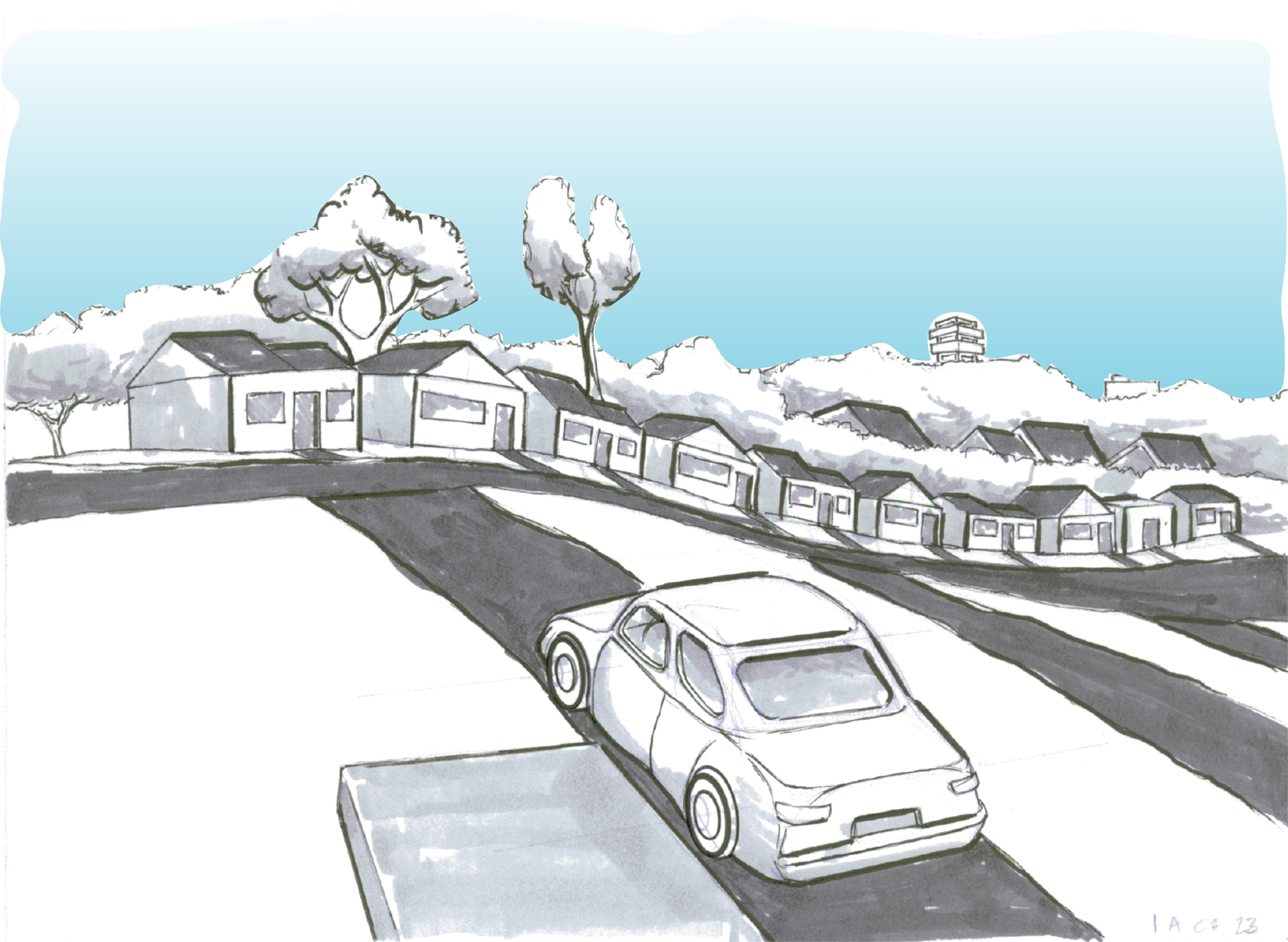
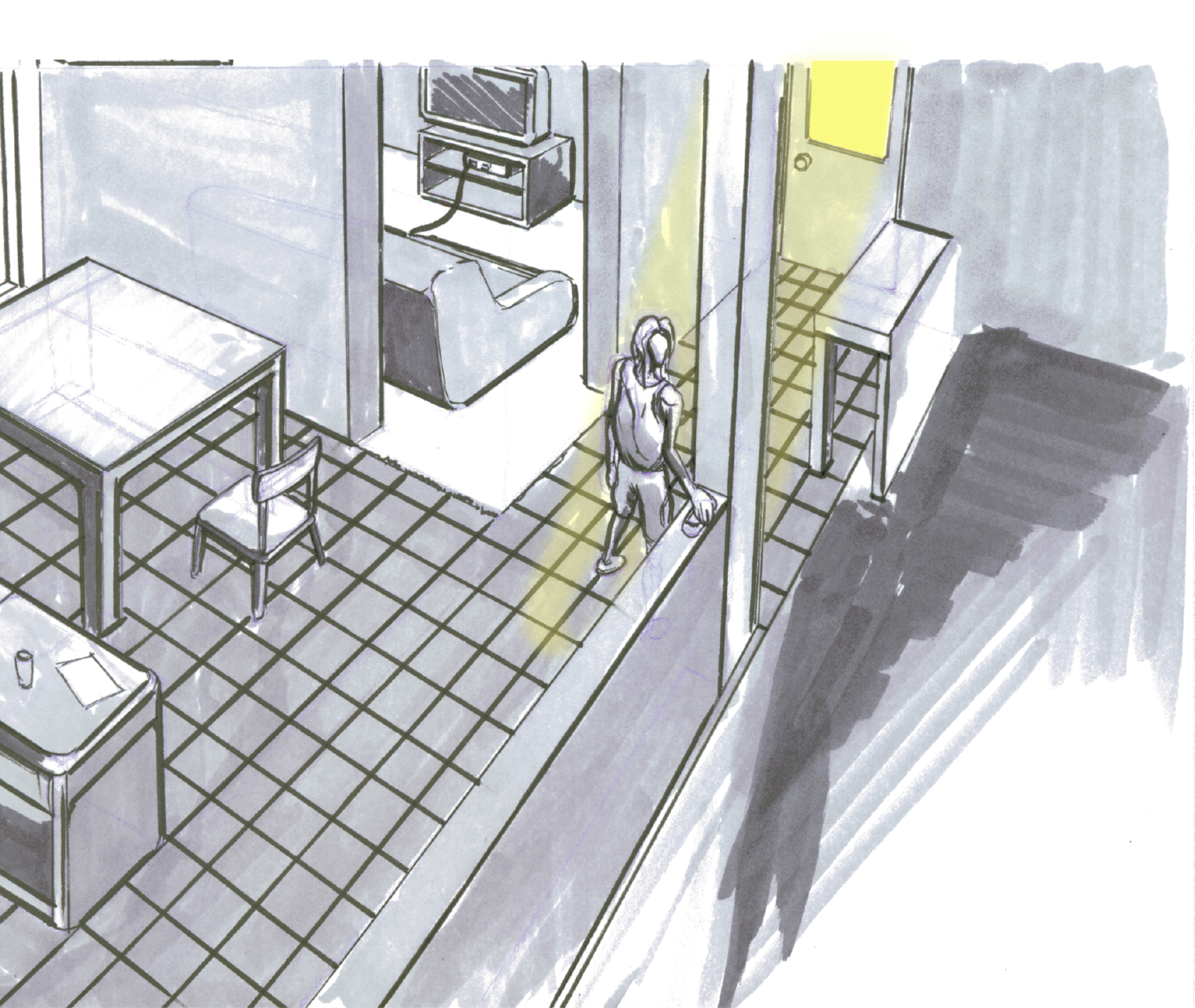
zone tactics. Evidence of June’s spread across the suburb of Newmarket came in the form of a deepening lushness in the grass and the blossoming of old growth oak and maple, tinging the air with pollen that would soon have Charmaine reaching for an anti- histamine. Saturday mornings were once spent at the living room games console, tackling RPGs and racers until her thumbs cried for relief, or until her dad suggested she vacate the TV so he could occupy himself for awhile with a Madden simulator or an actual televised game.
No problem today, as Charmaine was to try her hand at a new piece of software for her Gizmondo. The game, called “Zone Tactics”, is a next-generation game which makes full use of the Gizmondo’s location-specific functionality and includes some off-console potential as well. Designed to make use of the Gizmondo’s GPS functions, “Zone Tactics” is a game optimized for play in the outdoors. The game also allows for the integration of position sensing devices which can be configured according to the requirements of the players. For instance, a sensing device could be constructed to allow for it to be used in heavy-contact situations such as kinetic play activities, or configured to allow for it to be attached to other objects or persons. The sensing devices provide the basis for play activities that allow the physical environment in which play occurs to act as the game board through which players such as Charmaine play out a trans-reality fantasy.
Tobias is Charmaine’s friend from the Quaker Hill elementary school on Tower Hill. While Charmaine is walking up to the top of the hill, he had logged on to Gizmondo.com to upload new Phyzzles into his Zone Tactics software suite. Phyzzles are the term used to
describe a form of trans-reality game piece that is a combination of Physical control interface and dynamic three-dimensional Puzzle.
Phyzzles are the solution at which designers arrived when trying to figure out a method for allowing a virtual 3D puzzle like tetris to be
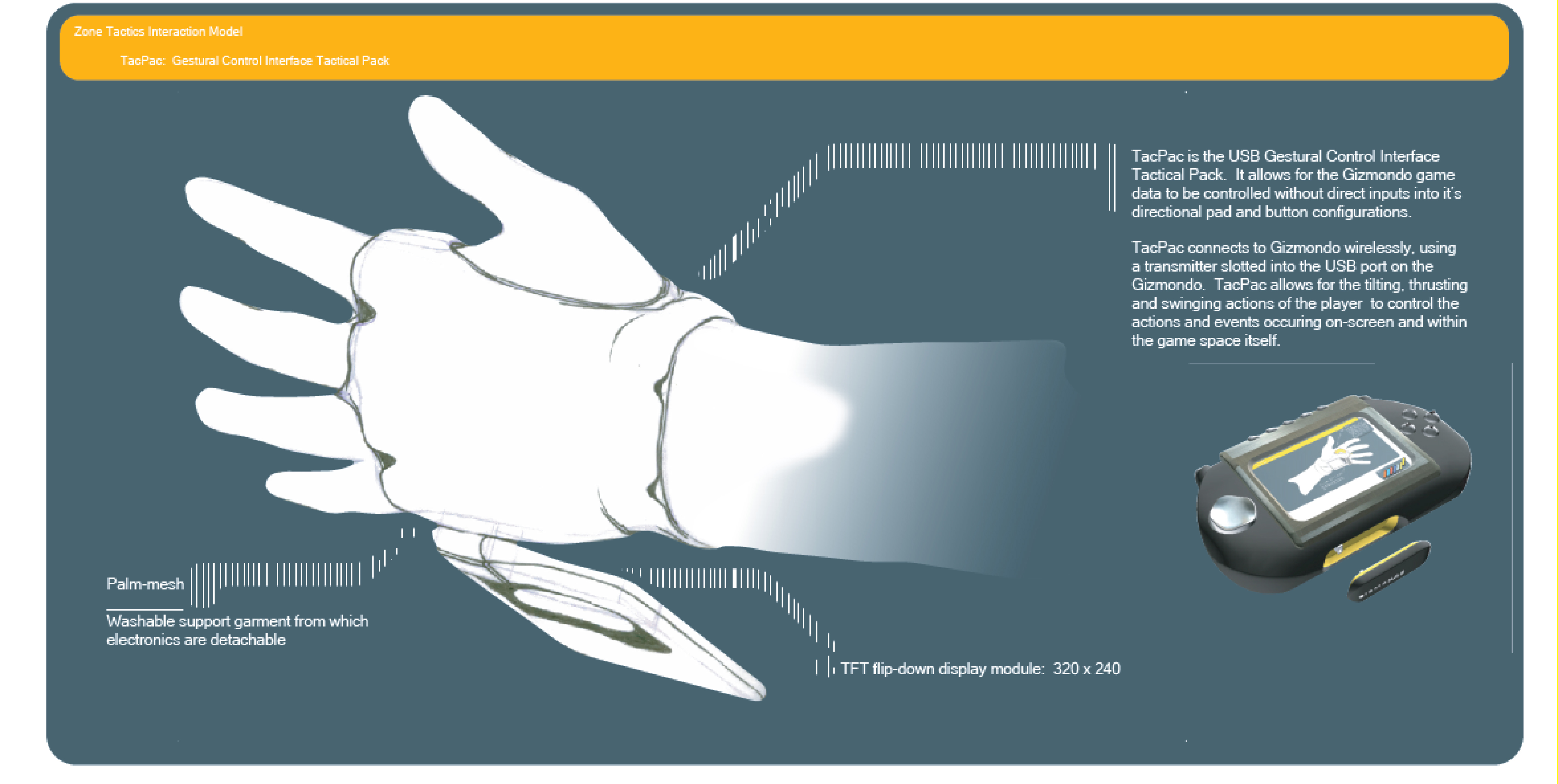
controlled with an interface similar to a rubics cube. The new Phyzzles that Tobias has downloaded are rotary puzzles. All movement within the Phyzzles occurs as a rotation, so they are easy to solve if you can recognize the pattern. After logging out, Tobias packs the Gizmondo into the TacPac. TacPac is the USB Gestural Control Interface Tactical Pack. It contains some simple articulated joints to allow the Gizmondo to be operated without direct inputs into it’s directional pad and button configurations. The TacPac connects to the Gizmondo wirelessly, using a transmitter slotted into the USB port on the Gizmondo. The TacPac allows for the tilting, thrusting and swinging actions of the player to control the actions and events both on-screen and within game space itself.
“Whatcha saying Tobias?”
Flashed an SMS message across the screen on Tobias’ Gizmondo, sent from Charmaine a few minutes earlier while he was online downloading the Phyzzles onto his deck.

“I have new class A Phyzzles Charmaine!” he dialed in on the TacPac.
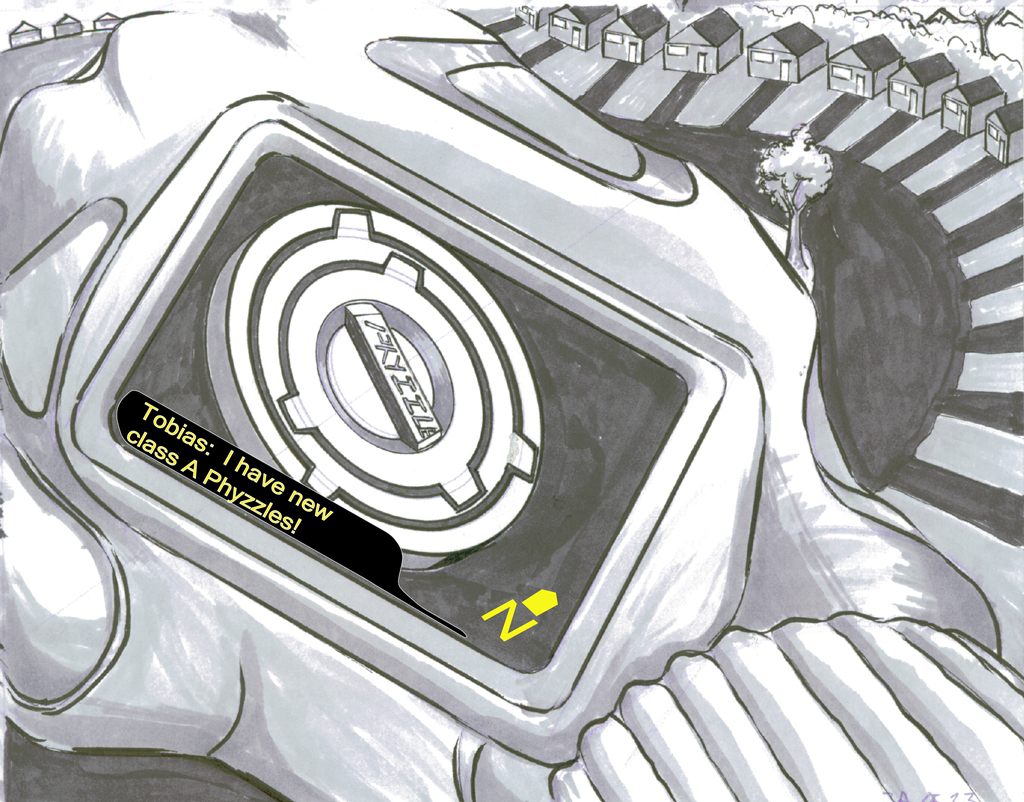
He pushed at the air to send her the message and pulled a zippered camo mesh sweater off the doorknob and draped the hood over his head, letting it fall behind him like a sniper’s concealment garment. The green of birch trees illuminated in the noon sun pierced the dim of his bedroom. The noon silence descended over his house, his mom was working at her office a few kilometers away and the cats had founded a mutual understanding that seperate spots would be used for napping. He didn’t see them as he stepped out into the
bluish glare on the wind-scrubbed concrete step. His mom’s unit hadn’t been around long enough for any vegetation to grow on the
property’s grounds. Everything, as far as he could go without needing to use the transit, was thouroughly modern and for the most part, new.
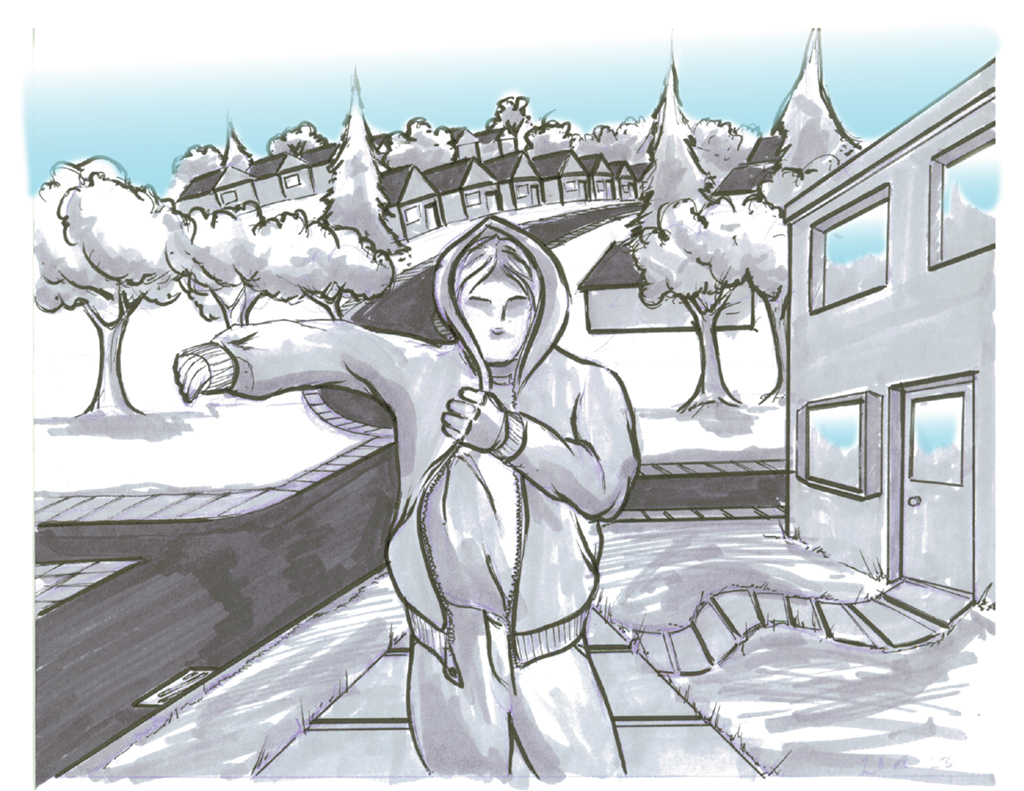
Not unlike most of the satellite settlements that are home to the millions of 905 residents in the new-urbanist sprawl that is the Greater Toronto Area, Newmarket had undergone a recent and explosive growth in both the population density and the establishment of modern infrastructure and properties to accomodate the influx of businesses, companies and corporations that chose to make it their base of operations. The highland clouds whipped by above with a fast enough clip that he could make out their advance, roiling and fading near the edges and providing just enough of a distraction that he didn’t notice the slight rumbling of the TacPac, meant to indicate that another SMS message was waiting.
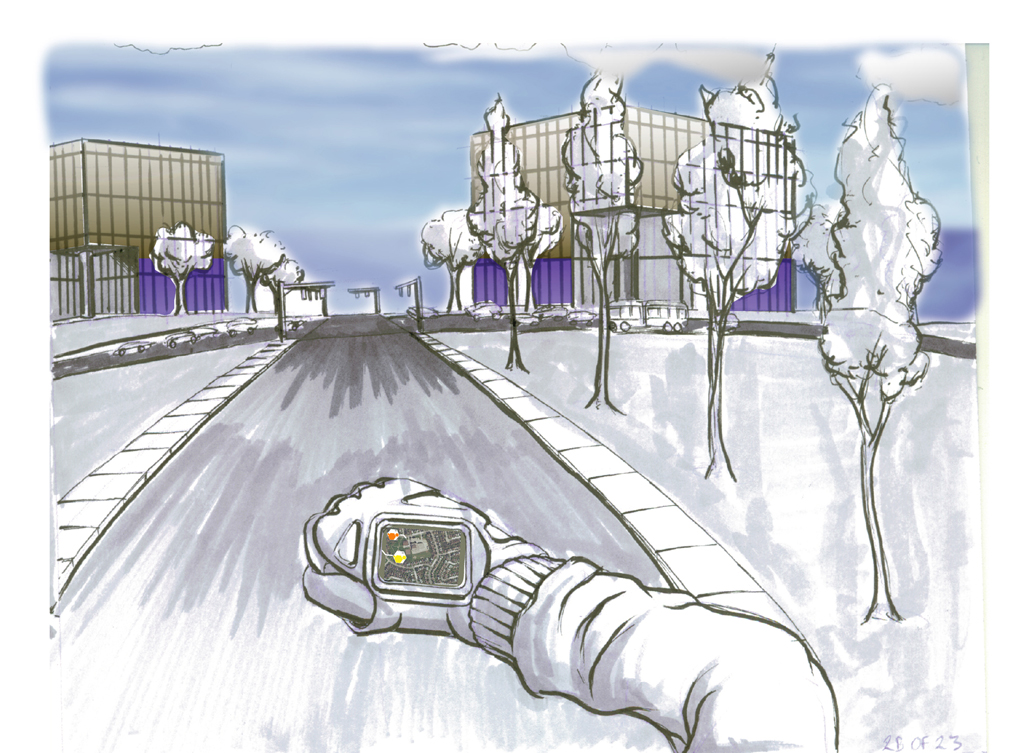
Charmaine: “I’m near the top of Tower Hill, meet me”.
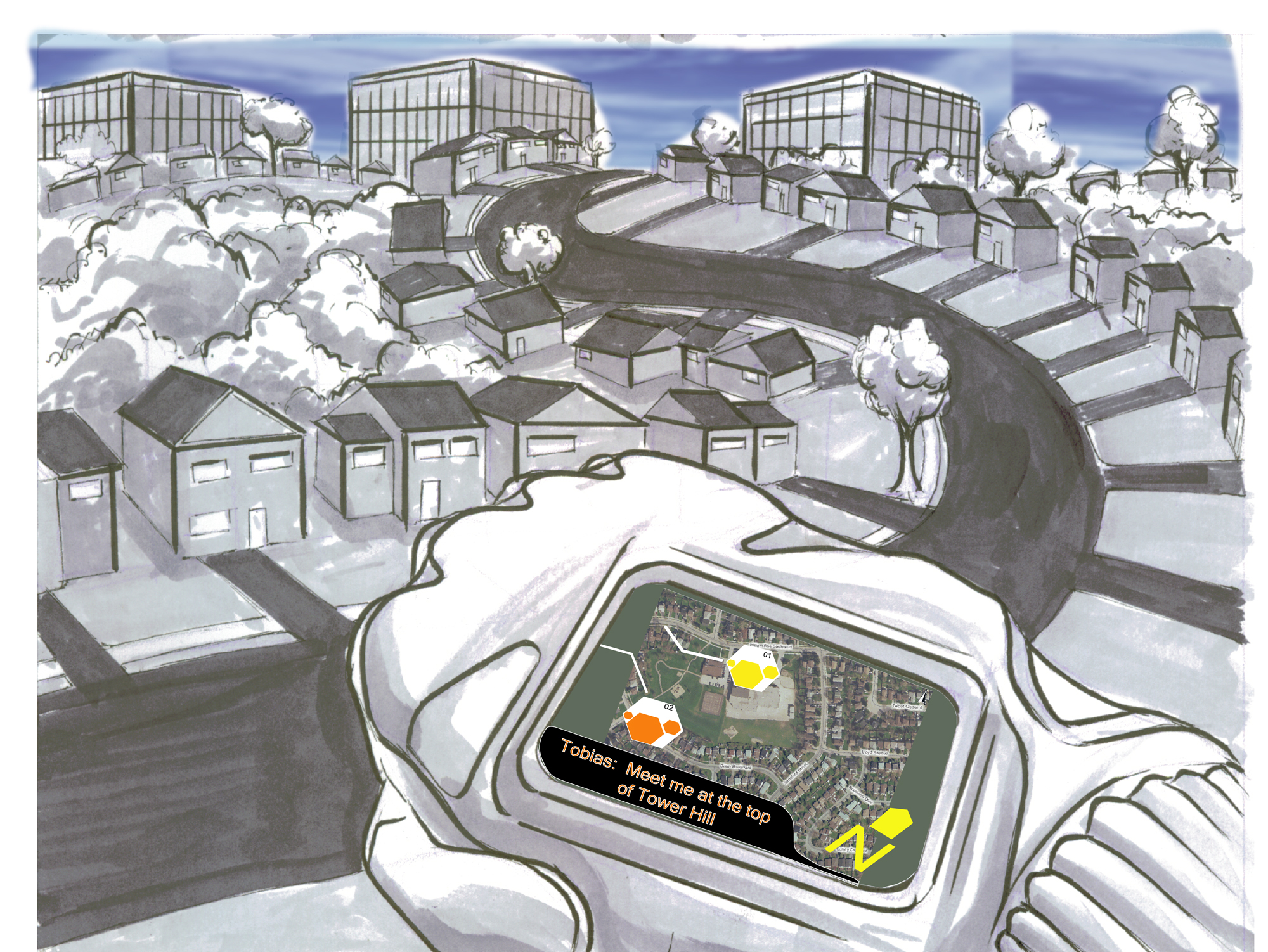
As Tobia’s crossed over the threshold between his street and the boulevard that led out to the edge of Tower Hill, he felt the crosswind whip across his back and decided to put on the sweater. He tugged the TacPac off the end of his hand and stopped to zip up the hoodie. He pulled the TacPac up his wrist again and flipped it to a stop to see Charmaine’s positional data on the GPS tab. Her avatar came up as a micro-sized version of the one she uses for most of her online activities. It looked like a little helicopter thingy, like an icon for a transporation-based meta-activity. It was a plastic-looking and improbable configuration for a flight craft which made him wonder why she had used that looking as it did like a specimen of Microsoft clip art. Tobias used a screen shot of a Phyzzle animation he made in the Zone Tactics Modelling and Animation Suite. It was chunky and bit-mapped to look like the skin of an attack helicopter, were it only as squat as a can of tuna and able to fly without a propeller.
Just as Charmaine was nearing the top of Tower Hill, she remembered that she wanted to show Tobias a glitch she had come across when playing an advanced stage of class A Phyzzles. There was a pattern in the Phyzzle rotation that appeared at random, an almost instantaneous whiteout that was speckled like sunlight hitting the turquoise PVC liner in a swimming pool during midday, In the model’s surface, she had glimpsed this weirdness and accidentally stopped the rotation, only to find that the animation froze to reveal that the blanked-out speckles were actually holes in the Phyzzle model that the designers had forgotten to patch up. She zoomed-in
the virtual camera to get the picture on-screen as crisp and clear as possible, only to see that hidden inside each Phyzzle were other
Phyzzles. That meant that any time you played Zone Tactics, there was only one model, it just contained the data for all the other possible configurations that a Phyzzle could assume. It was like they were packed in there in a fractal heirarchy, the Phyzzles within Phyzzles within Phyzzles holding vast quantities of geometric data and animation algorithms like the structure of atomic material forming a lattice-work constituting the strands of DNA. Tobias was as able to appreciate the same quirks found in games as Charmaine, it was just that his understanding seemd to stop at the surfactant details. He obsessed over the texture and bump maps that they played with, and even asked one day if she had gotten the photo for her avatar from Clip Art. It bothered her but she didn’t say anything. That’s just the way he is going to be. And she’d still kick his ass.
Tower hill was a redevelopment along the Yonge street corridor which was designed to increase the residential and commercial property density near the major intersections of courts and civil services in the south-central area of Newmarket. Several sixties-era strip malls, low brick-clad boxes designed and built for economy were razed and a series of cobalt-coloured glass cubes were erected on the hill leading north to the the town’s first European settlement; a community of Quakers who had formed a habituation on the semi-forested scrub that looked near-identical to some rolling expanse of northern Scotland. The cubes were at least seventy metres on a side, staggered in a line with the second in line from the south perched nearly beside and about five stories above Yonge street. This allowed the sight line to the north to be obscured to a minumum. The cubes contained a mix of business properties and goverment administration offices to complement the office complex situated less than a kilometer to the north. Tower hill presented long a long, uninterrupted expanse of landscaped fields and treed areas that had been implanted where before there had been only gravel lots and parking garages for the seniors apartments that had originally given Tower Hill it’s name.
The TacPac showed that Charmaine was less than one hundred metres to the east, nearing the top of Tower hill. Tobias swung the TacPac up towards his elbow where he felt it click into place on magnetic riser plates. All he had to do to drop it down again was to swing his arm outwards at a critical velocity and the TacPac would detect the change in speed and temporarily reverse the polarity of the magnets, dropping forward to where he could see the screen and aim the deck at whatever he wanted to interact with. He dropped it down again and cycled it to it’s scope function and scanned the eastern horizon, looking for Charmaine but at the same time hoping to see her before she could see him. He found the scope to be an amusing little bit of kit. He could make out the text on signs long before he actually reached them, and take pics of whatever was on-screen. He liked to take snaps of his friends and e-mail them with the pics as attachements, leaving them with the impression that he was maybe an amateur paparrazi or policeintelligence type. He liked letting people know that he had his eye on them.
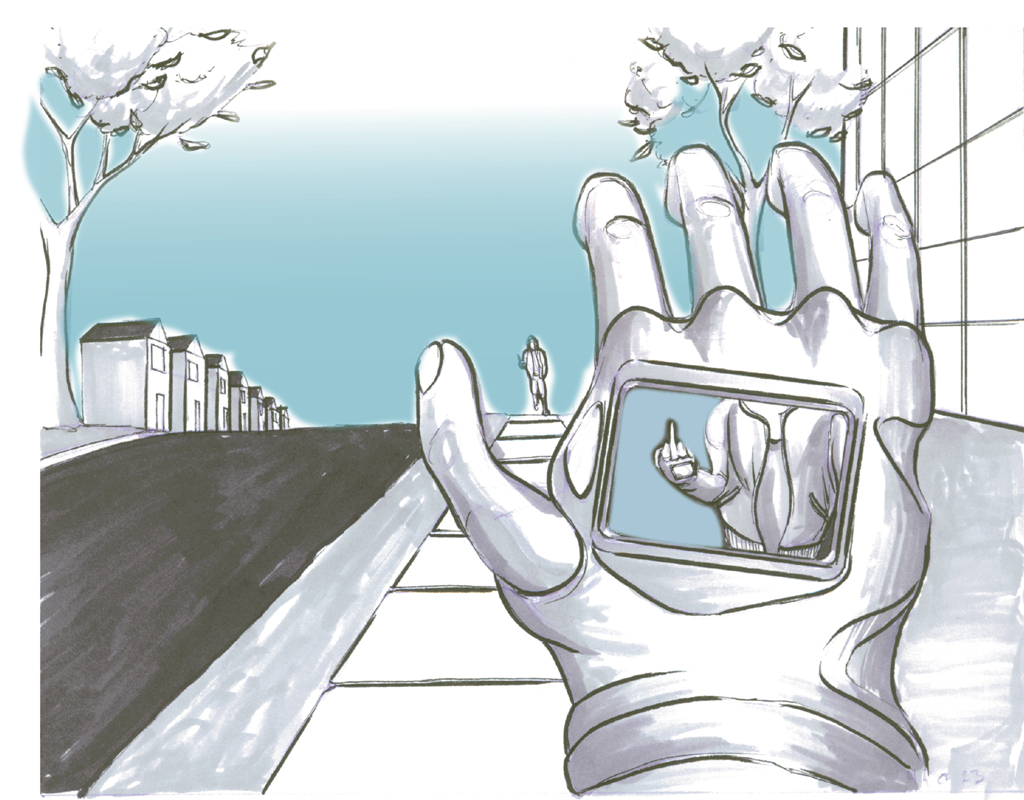
Charmaine appeared on the boulevard, moving towards him with a stroll so controlled and symmetical that she could have easily
been mistaken for being an animation herself. She raised her hand and extended it forward, where Tobias could see her raised middle
finger resolve on screen, an unmistakable gesture meant to indicate that the intrusion was not welcome, Tobias walked for a few minutes more, stopping at the wide intersection, more than six lanes across. Charmaine slowed her pace in front of tower two, suspended nearly above the roadway.
The noon sun had passed it’s apex and begun it’s descent into the evening, although none of this is apparent in the moment in which
the stirring to play has left the mind affixed on the vastness of the visual terrain’s geometric vacuity. Only time to waste by ranging throughout the city, seeing what they could find in the interstices between the “places” that sequence the town into grids and events. Places which were travelled through in a car or on a bus. Places that had no real connection unless you felt it out by exploring within the boundaries between them. The lights cycled to green and Tobias stalked out across the intersection, feeling slight in front of the wave of Saturday noon traffic that had been brought to a halt just so that he could cross the street. He then imagines traffic engineers in some cramped office downtown, having no choice but to program the crossing signal to be as short as legally possible so as to minimize the economic loss incurred by the region due to traffic gridlock caused by pedestrian nusciances like cross-walks. Just as he reaches the halfway point, the light begins to signal stop. He bounds across the last few lanes, suddenly aware that his pulse is racing for reasons not immediately clear.
“What’s up Tobias?” blurts Charmaine, as if to overcome some cognitive dissonance interfering with his ability to respond verballly. “What do you mean ‘what’s up’?” he came back, his head tilting over as if to focus his senses upon the source of the stimulus.
“You said you got a hold of new class A Phyzzles.”
Tobias nodded, smiling as if her inquiry were a commendation.
“I did!” he shot out, redirecting his focus to the next concern at hand.
“Where should we play?” Charmaine glanced around and looked south to the foot of Tower one and the intersection beyond it, glittering with the constellation of windshields reflecting the midday sun overhead. It was usually the case that boundaries were drawn automatically and you were always within some sort of play area. With only two players they would have to go somewhere out of the way, where they could just play without traffic or distractions. She pointed to the shadow falling in behind the cube, enough coverage that they wouldn’t always catch the glare of the sun in the Gizmondo optics.
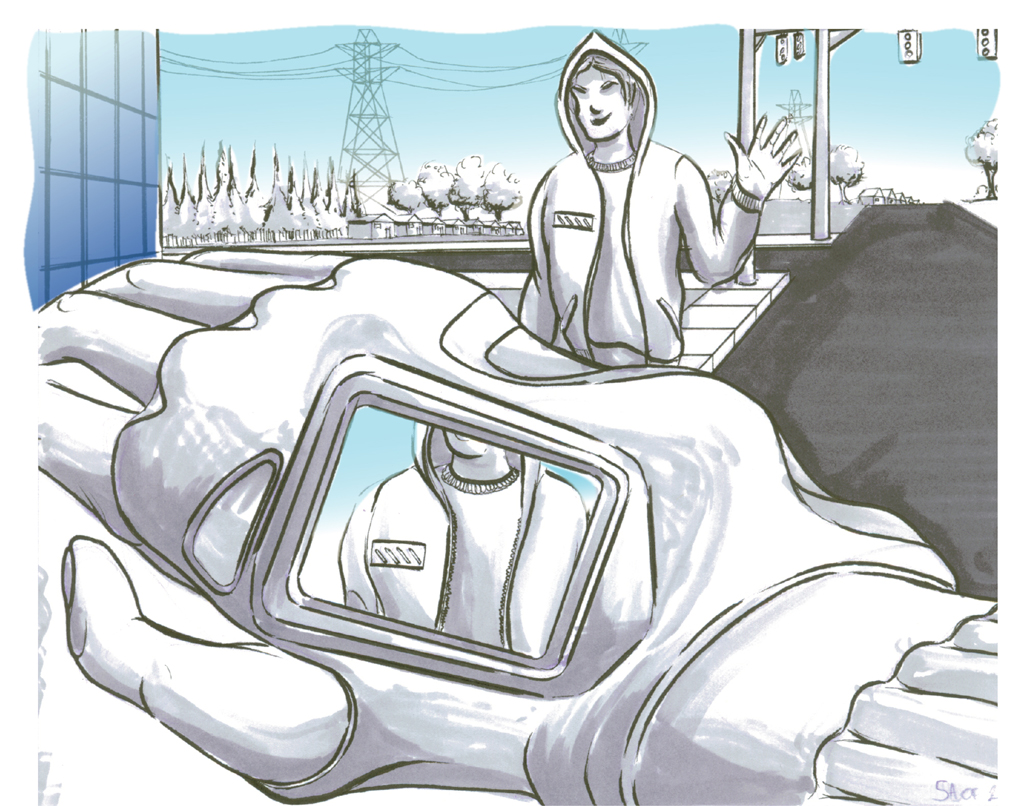
“Lets go down by the first cube.” She started off but stopped, startling Tobias when he saw that she had raised her TacPac into offensive capture mode. An orange pulsing of light beside the TacPac camera eyelet indicated that she was threatening to capture an infra-red image of Tobias’ Signal Patch.
“I’ve got a lock on you Toby.” He stood frozen, realizing that she had gotten the drop on him, starting a game of Optic Capture tag
without actually warning him. She squeezed the shutter action and her deck emitted a synthetic click. She let out a noise like a tickled toddler giggling and burst into a sprint across the lawns. These were formed into something like a wide and low staircase, landscaped grass plateaus stacked one on top of another with bush and cedar stands near the edge of the road.
“Yeah Charmaine, okay.” Tobias called after her, dropping his TacPac into capture mode and taking off after her, not particularly
pleased at the change in plans and not making any evident effort to run her down. She had gone more than two hundred feet and was concealing herself behind the eastern corner of the cube, knowing that Tobias wouldn’t be able to get a lock unless he had a clear view of her signal patch. She looked out at him, not bothering to zoom him in on the TacPac. She wanted him to try and get close, at which point she would run towards the western edge of the cube, and on it would go, like they were chasing each other around a massive square tree-stump.
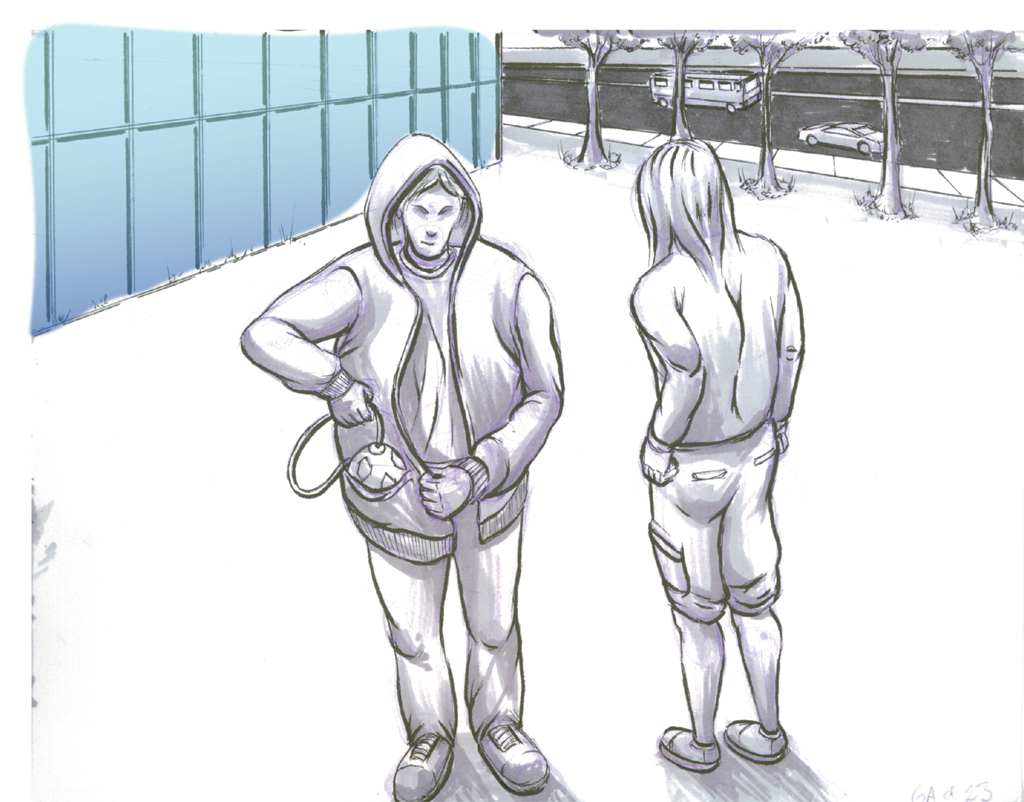
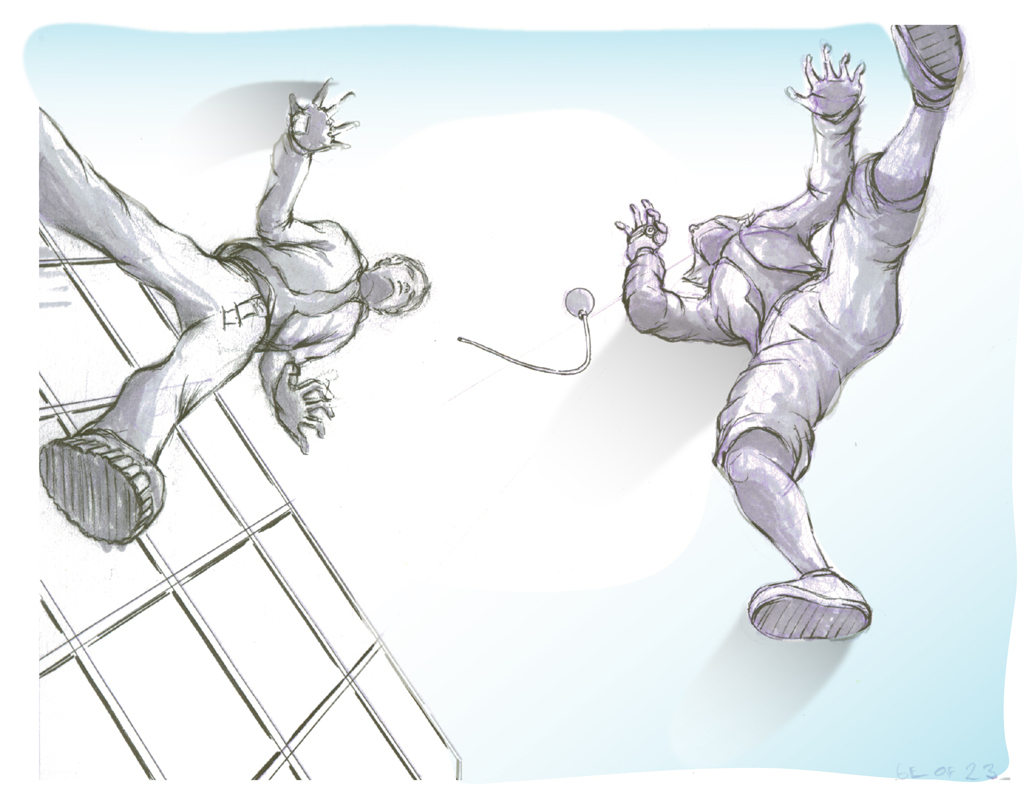
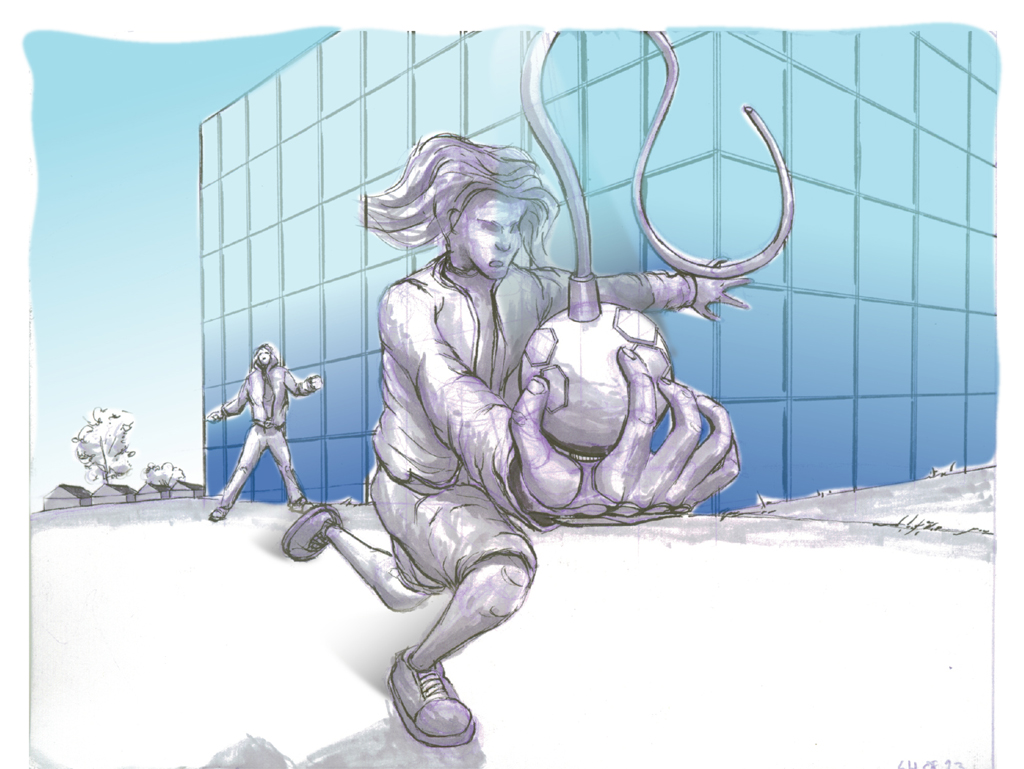
Tobias had opened the flap covering the pouch built into the back of his zip-up. Pulling out the Orbit as he disentangled its cord from itself, he began swinging it around his head faster and faster until it let out a soft whump like a styrofoam helicopter blade. He launched forward like
a discus thrower and let the Orbit fly free.

It shot up into a parabolic arc high above the lawn. Charmaine stood up and ran from out behind the cube, on course to intercept the Orbit. She had the TacPac extended as far as it could go, it’s camera in line with the Orbit. She saw the Orbit pixellate into a Phyzzle animation, tumbling around and around and filling out the screen as it descended. She waited for it, caught the pattern, and snapped the trigger.
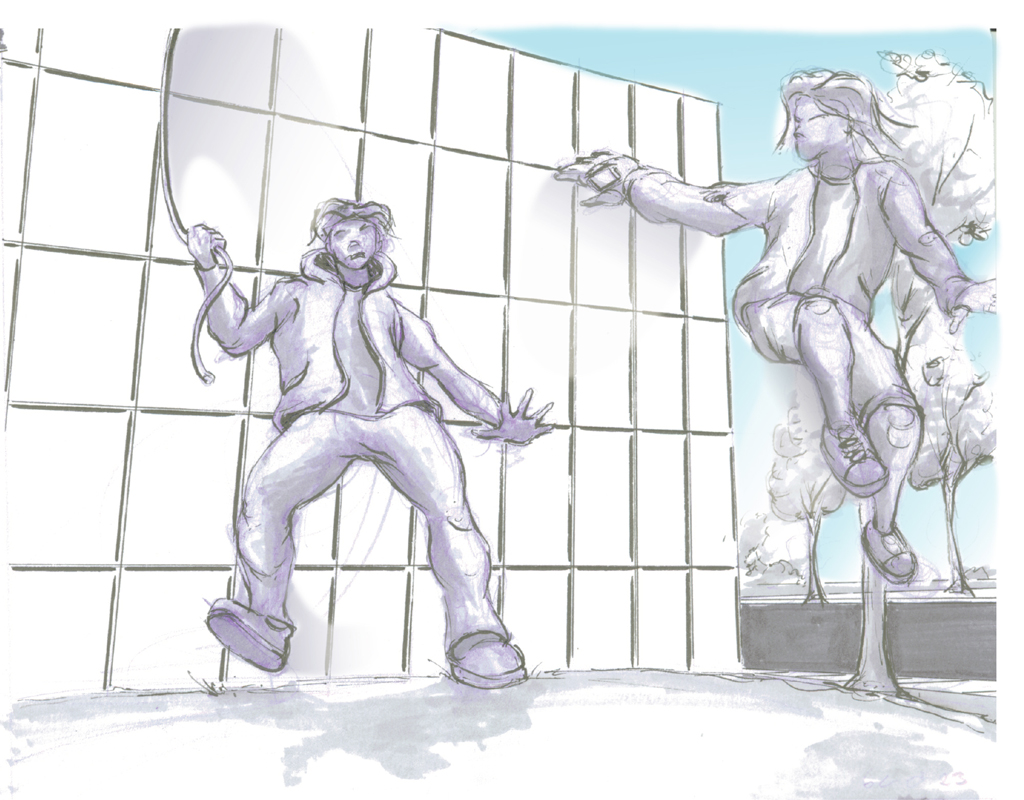
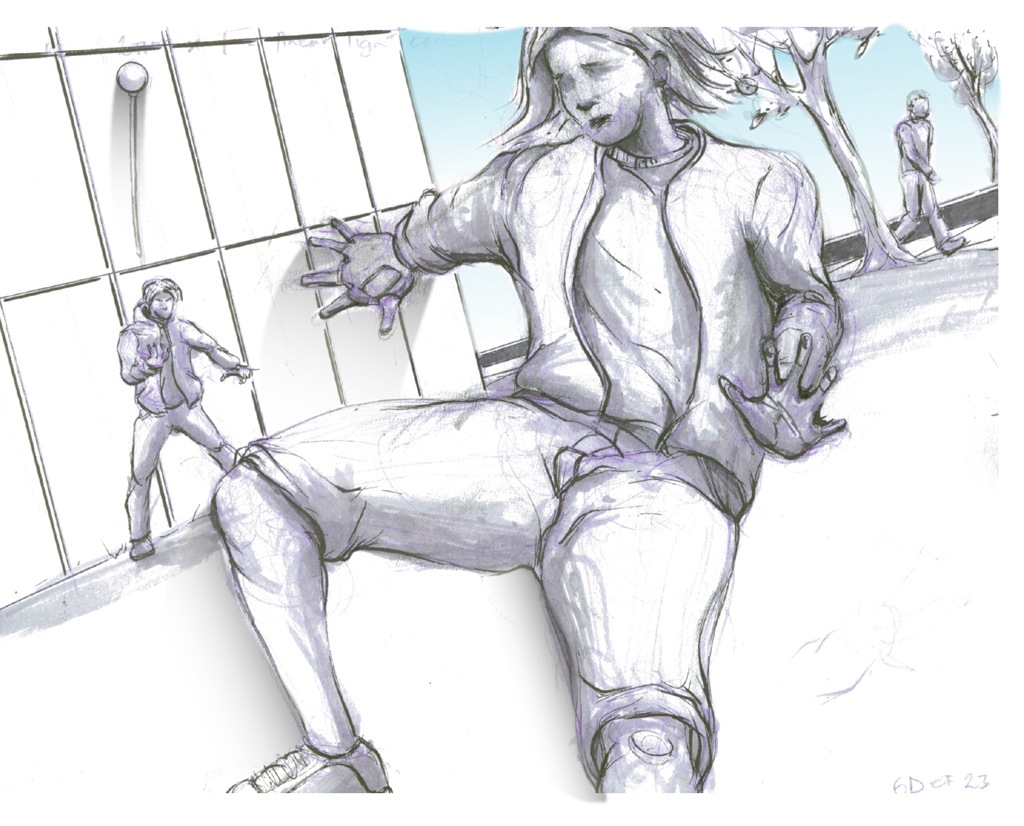
The Phyzzle animation froze, the shapes interlocked like a perfect volume of Tetris bricks.
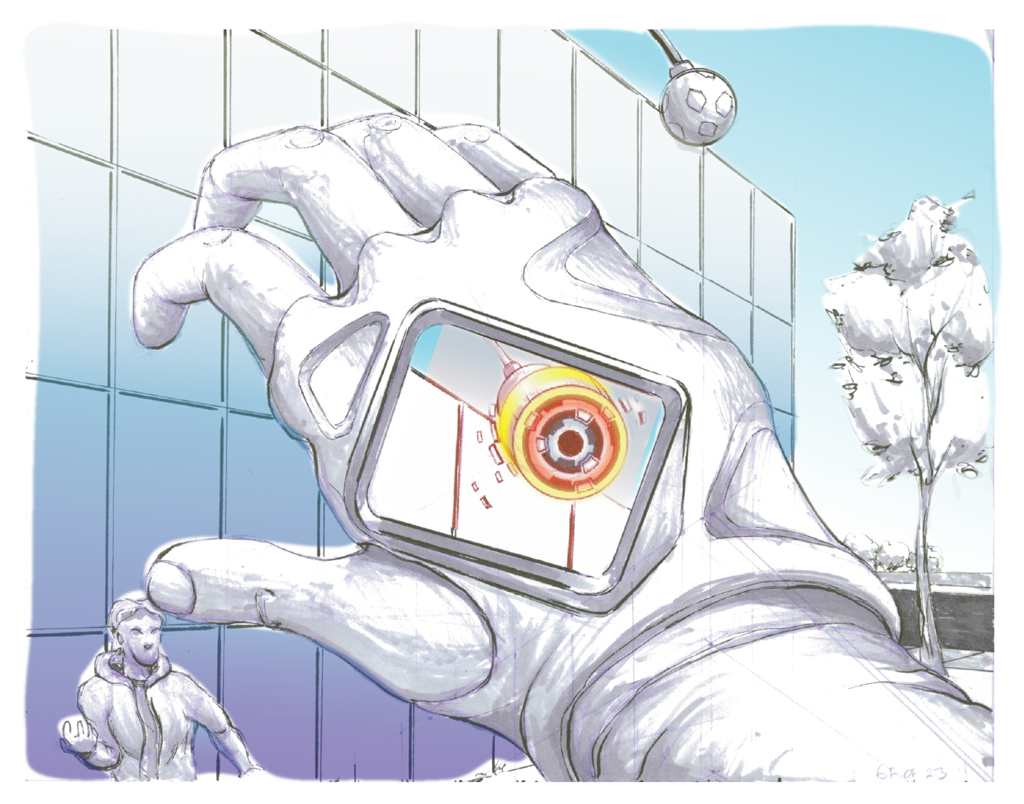
“Score!” came across the screen, indicating that Charmaine had halted the rotation at the critical moment, every component
of the Phyzzle model fitting together seamlessly.
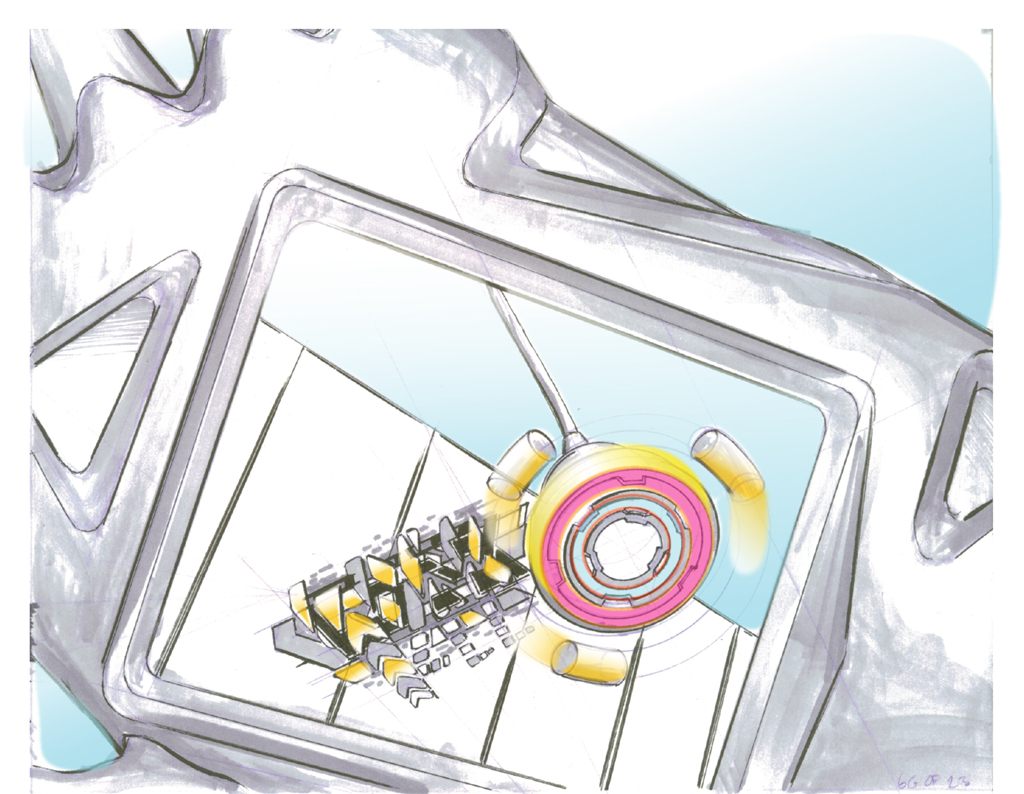
The Orbit continued it’s descent, Charmaine lunging to catch it with the same hand to which her TacPac was attached. It was possible to play Phyzzles so that points could be deducted for missing or dropping the Orbit, it was just that this could complicate a game by further involving dynamic motion as a critical factor. You could score by solving a highly complex pattern, only to lose points
by missing or dropping the Orbit.
Charmaine took the Orbit cord in her hand and swung it around, launching it upwards into a wide and erratic arc, knowing it would fall short of where Tobias was standing. It took him a second to register that he would actually have to move quickly to reach it before it hit the ground.
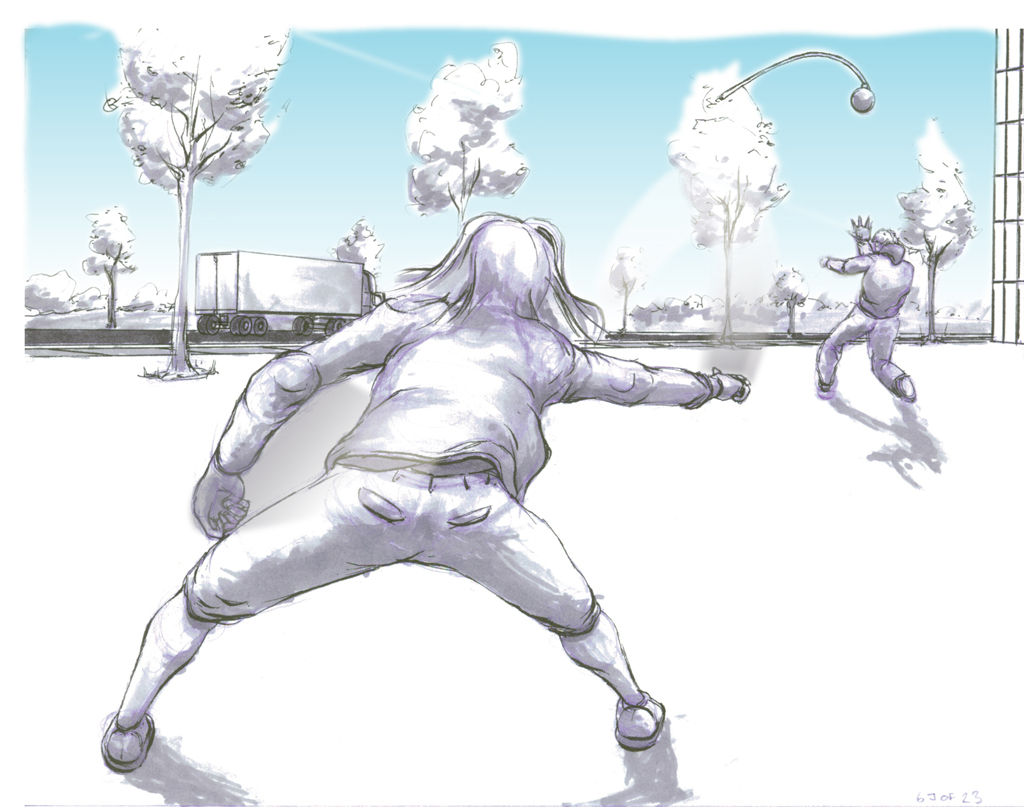
Scrambling towards it like and outfielder, he raised the TacPac and acquired the Orbit on screen. He saw the image of the Orbit pixellate for an instant and transform into the Phyzzle model, winding around like a TV-coloured cyclone, cut into sharp angular
bodies that overlapped as they passed through one another in mutually opposed directions. He slowed his pace, concentrating on the Phyzzle and waiting for the patterns to merge. At the last possible instant, he tapped the trigger, freezing the animation and scoring a point.
This carried on for a while longer, with the Phyzzle animations gradually becoming more complex and increasing in their rate of rotation. After approximately twenty minutes had elapsed, Tobias trailed Charmaine by a few points but this was the expected outcome. She was a class A virtual athlete, a razor-sharp hybrid of ninja-like hand-eye coordination skills and proprioceptive acuity that enabled her to excel at full-spectrum trans-reality games, a veritable “Zone Tactician”.
Zone Tactician or not, time tended to slip away when your gaze remained skyward. Steel nerves and the capacity to move at a rapid rate over open ground were the physiological attributes expressed in this next generation of child-gamers. Taken for granted was the technology. The game was a device-mediated construct used by the body to allow the person living it to better know understand it’s limits. The game serves as a threshold by which means virtual play occuring within the physical world is able to stimulate the physical growth and social maturation of the person who plays it.
“Tobias.”
“Yes?”
“I saw something in one of the Phyzzles we were playing with last week.” Charmaine moved forward with the TacPac, a still image visible on-screen. He glanced down and then grasped the deck, turning it so it faced him.
“It looks like a hole.”
“There’s Phyzzles inside, and strands of lines and bars.”
“Where did you see that?”
She zoomed the screen in on the frozen model, the anti-aliasing flickering at the edges in a travelling-wave of illuminated polygons, like a ghost swiping a set of keys on a casio. Beyond this rupture in the Phyzzle model, Tobias could see other Phyzzles suspended in recursive patterns, spiralling down into the abyss near the center of the volume.
“Why do you think the models are built like that?
Charmaine paused before the reply. Then her eyes tracked to his and affixed his attention. She began, looking through him, as if she were reading the words to her reponse from a blackboard suspended above his retina.
”I think it has something to do with the loading of new Phyzzles on-screen. They’re contained in whatever model your playing with at
the moment, and come on screen full-size. Maybe the model from before doesn’t dissappear, it just goes really small.”
“Your probably right.”
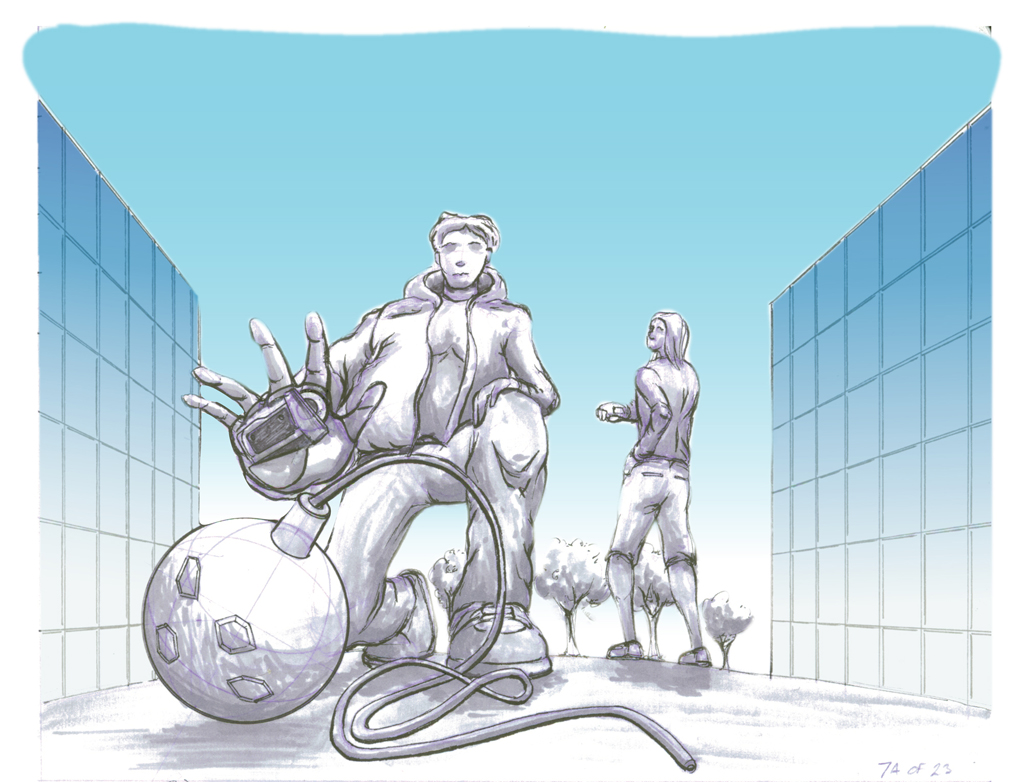
Tobias was coiling the strap of the Orbit around the body, and tucking it into the pouch of his zip-up.
“Do you want to find Eddy and Lucas?” Charmaine asked, rolling an axis on the TacPac‘s palm gyro. The screen panned over the GPS tab. She could see a slow motion film, one frame per second, with the avatars of herself and Tobias visible in a photographic image of Tower hill shot from above. She aimed the eyelet of the scope in the direction of Tobias and tapped the trigger, capturing his signature. Flipping back to the GPS screen, Tobias’ avatar was highlighted in neon pink, showing that he had been captured.
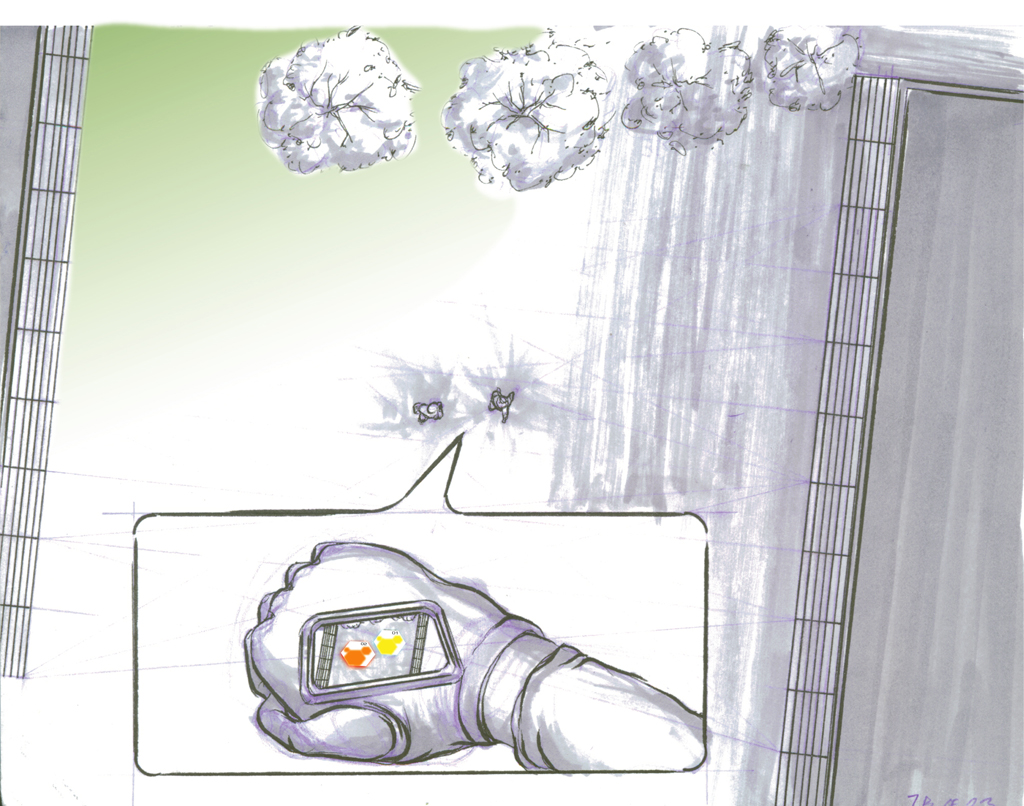
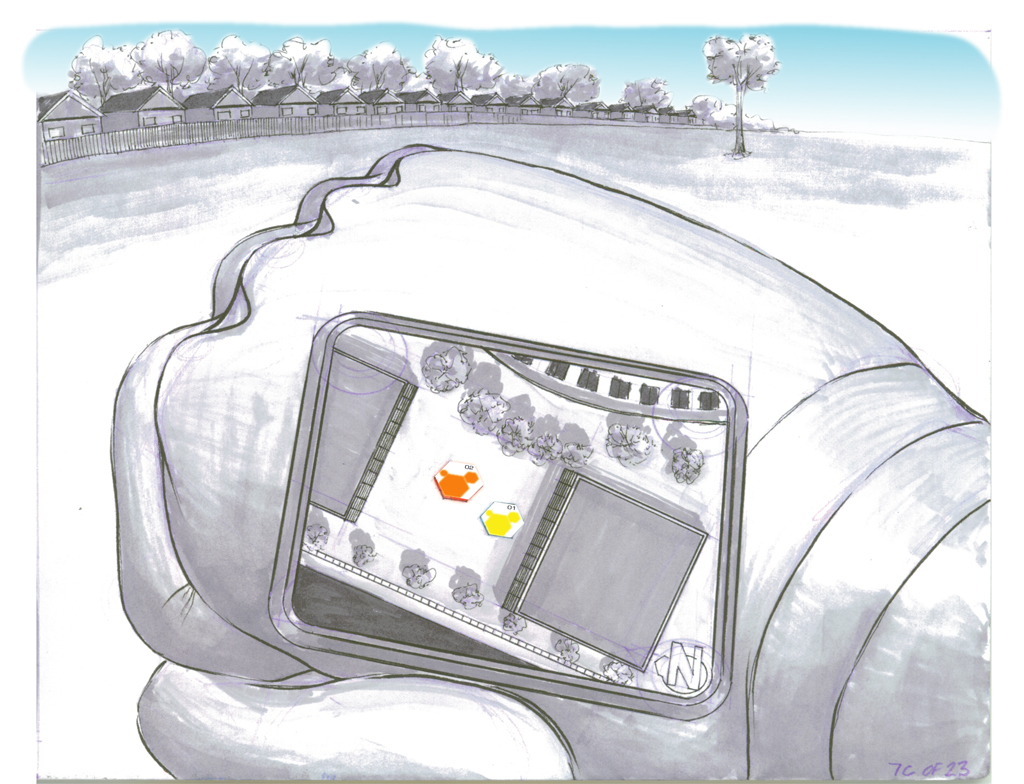
“How do you want to do this Tobias?”
“Lets see if they want to go play Fallout down in the quadrant.” He came back, his attention momentarily diverted from his deliberated ritual of packing the Orbit in his pouch in the most compact configuation possible.
“Ok Charmaine, you want to play optic capture?” Tobias charged, almost annoyed that she had persisted for as long as she had already. Charmaine’s eyes lit up, her stomach stirring with the anticipation of flight. She turned away from Tobias, setting the countdown for her getaway.
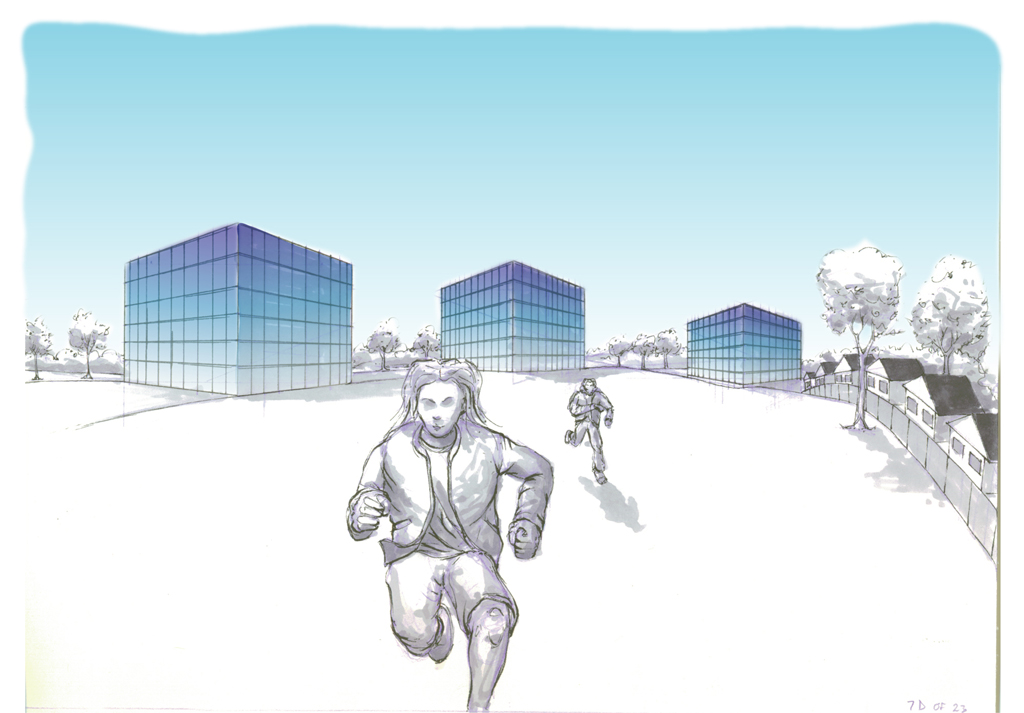
“You’ve got thirty seconds before your capture function activates.” She was referring to his TacPac’s optical capture function, it had been temporarily disabled when Charmaine had captured his an image of his Signal Patch. Tobias would have to wait for the timer on Charmaine’s deck to count down to zero before he could go after her. This let her get away and find a hiding spot. His capture function would activate, then he could track her with the GPS tab, which would provide a real-world photo of the play environment with her avatar displayed in it’s approximate realworld position.
She was running now, full out towards a concrete pathway that connected a townhouse complex to the college on the north-east corner of the big intersection. The older big-box retail strips were now visible from behind the hulk of the sourthernmost cube. The sense of scale suddenly morphed into one of horizontal emphasis. She could make out the hectic afternoon traffic of the parking lots across the road. The grass seemed a little hardier down here, drowned several times over by the torrents or rain that course through the artificial storm-water channel. She turned around to see the tiny figure of Tobias, back up near the cube, menacing and stealth in his camoflage hood. He was running now, though for how long she couldn’t be sure. She ran through maps in her mind, the secret routes which led over twisted fences and through bush. She knew she could back-track through the rear of the Honda dealership, but she would have to get around the side of the garage, which meant going over a tall fence.
Tobias was less than 100 metres away now, she could see his avatar lit up bright pink, pulsing slowly as the GPS feed refreshed itself. She ran towards a cedar hedge beside the fence and pushed aside a branch to reveal a smaller fence. This wouldn’t pose a problem, she thought and pulled herself over up and over. She landed in a gravel lot that opened onto the main roadway, and ran out across, trying to put as much distance between herself and Tobias as she could. She checked the screen to get a fix on Tobias. He had slowed down in the gully, pausing where she had just been. He was trying to figure which way she had gone, but it was impossible to tell. She made it across the lot and paused at the end of the fence. She would be able to crawl in between it and the hedge, using it as cover while she waited.
Tobias had gotten into the Honda lot from the rear, taking the more difficult but direct route. He scaled a small retaining wall and hit
a fence at the top of it, landing in the shadow of the main garage. There were some CR-V’s and trucks lined along the fence, the white
protective film from the paint factory still clinging to their front and sides. They might have been patients in an dentist’s office, waiting to enter the bay and have a mechanic rattle around beneath the hood. He knew that Charmaine was close, thier avatars were side by side. He kept low, moving like the lioness stalking an antelope. He came out from the side of the garage and moved towards the gravel lot surrounded by the cedar hedge, advancing cautiously but not seeing any sign of Charmaine.
The wind had warmed, the smell of diesal exhaust was faintly present. The starkness of the lot with the sun overhead was at once unsettling and totally unremarkable. Where was Charmaine hiding?
Tobias heard an alarm tone, Charmaine had acquired a lock-on and was about to take another capture to score a point and paralyze
his TacPac’s capture function again She could see him but he couldn’t see her. He started to run in a zig zag pattern, his erratic movements breaking her lock-on and allowing him a few seconds to find a hiding spot. He hit a left so hard that his sneakers slipped on the grass. He slid to a stop and crawled in under the hedge.
“Try that again Charmaine, I dare you!” he called out across the lot, half expecting her appear beside him like a snake, having slithered
up from below the ground to crawl across his lap. He was tense and alert now, watching and listening for any sign of where she was hiding.
He was still now, the only sound was the wash of traffic and the whisper of the wind passing across the tops of the hedges. He felt the
hedge shiver, like something had started to shake it from above. He looked up to see Charmaine, dropping down from the upper branches where she had been perched on top the thickest, most overgrown section. He felt the ground thump as she landed hard and walked over to where he was hiding.
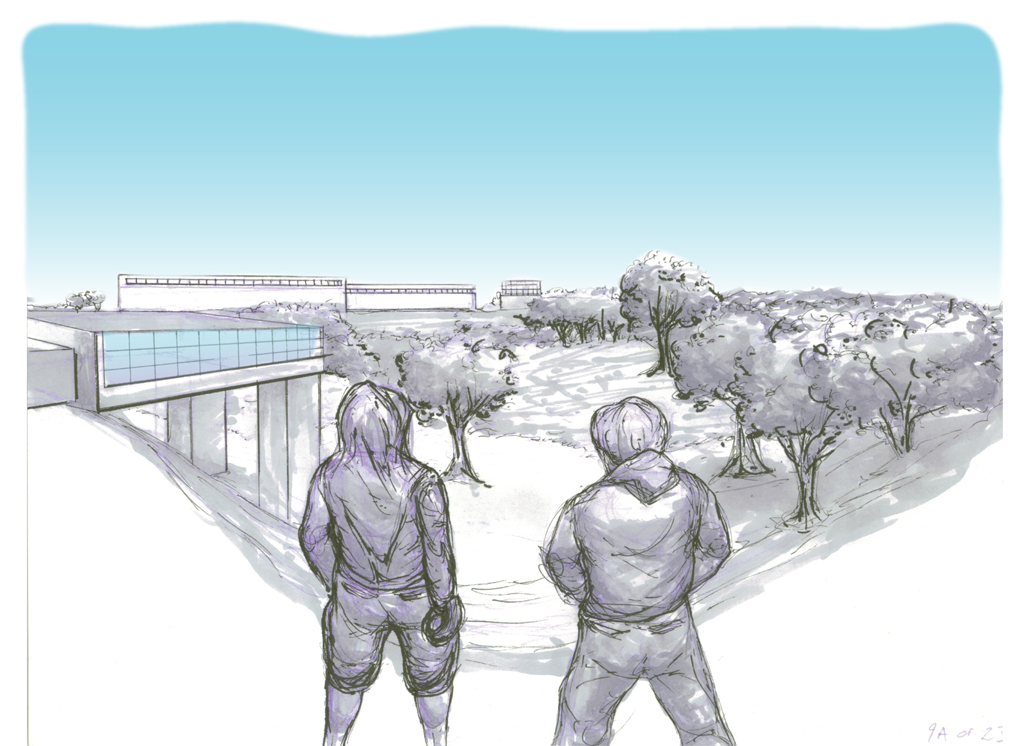
“Lets go find Lucas and Eddy now.” She called to him. The game was wearing thin with just the two them. Along with Lucas and Eddy, they would go a bit further east, towards the conservation area. This was a good location for pretty much any type of “Zone Tactics” game, but it was especially well suited to Optic Capture tag. With enough players though, they would be able to play “Fallout”, which was similar to ‘Capture the Flag’. By forming teams, they would be able to cover a larger area and use a combination of text messages and two-way radio to coordinate their actions and avoid optic capture by the other team.
In the game Fallout, a randomly chosen GPS coordinate represented an imaginary ‘isotope’ that either team was assigned to protect, at the same time trying to capture the opposing team’s isotope before the timer ran out.
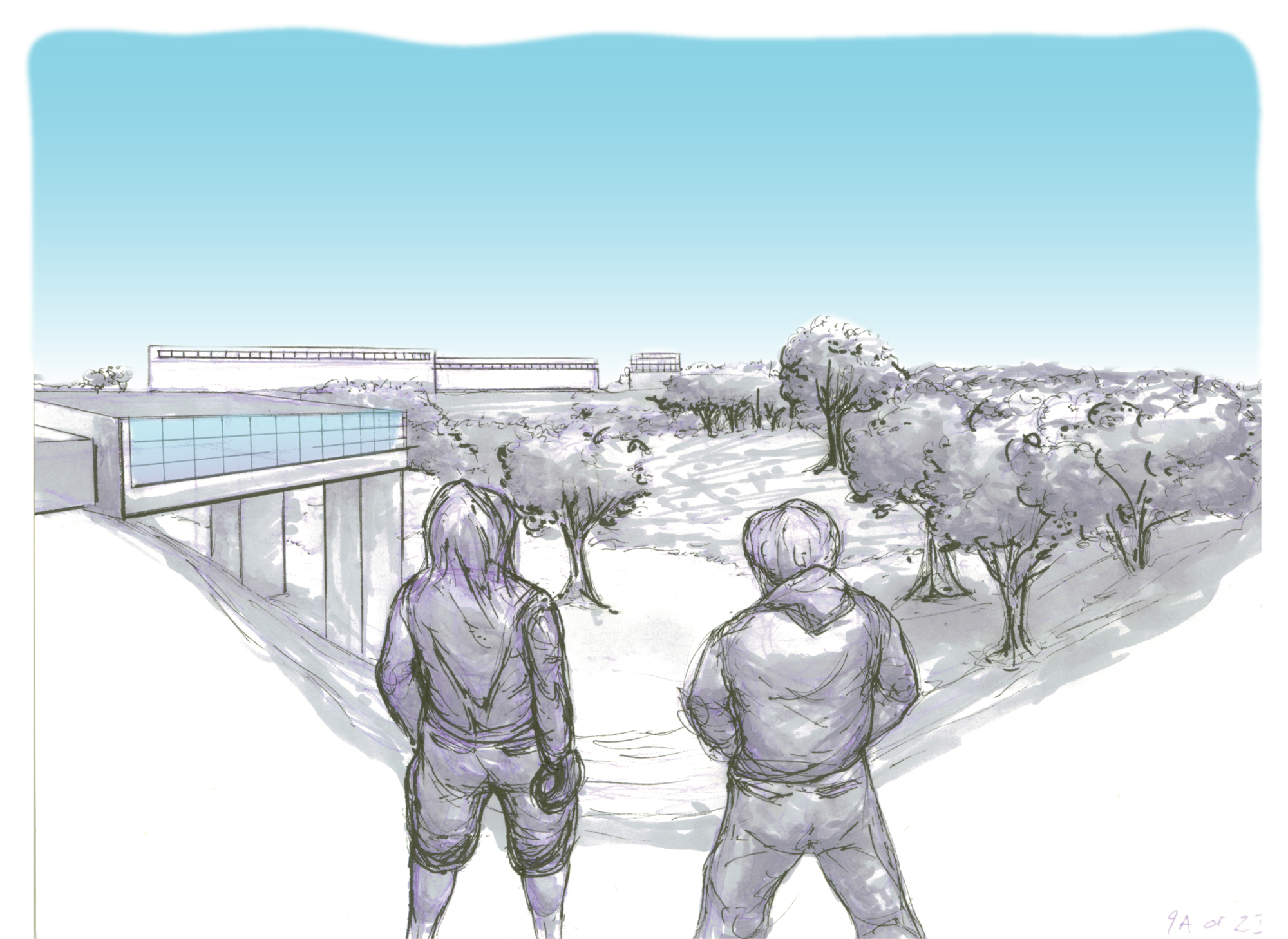
The civic centre was a ‘smart building’, constructed on top of an expanse of field, in between a cement factory and a gas station.
The civic center consisted of odd rectangular pods of different sizes and orientations, clad in cedar and glass. They sat on top of concrete pylons that were sunk deep into the natural wetlands. Beneath these pods were trails that led out into a vast conservation area. Visible beyond the pods, one could see old-growth forests, the canopy rising to nearly one hundred feet. The treetops whipped around in the breeze, waves of warm, clear air animating the tops like green billowing clouds. The underside would be cool and quiet.
A river cut into the eastern edge of these woods, curving back out towards the car-part factory before passing by the grew towers of the cement factory. The area could have passed for a miniature NASA flight center, the cement plant’s water towers affixed to the massive grew conveyor stacks like a Russian Futurist painting of a steampowered Space Shuttle.
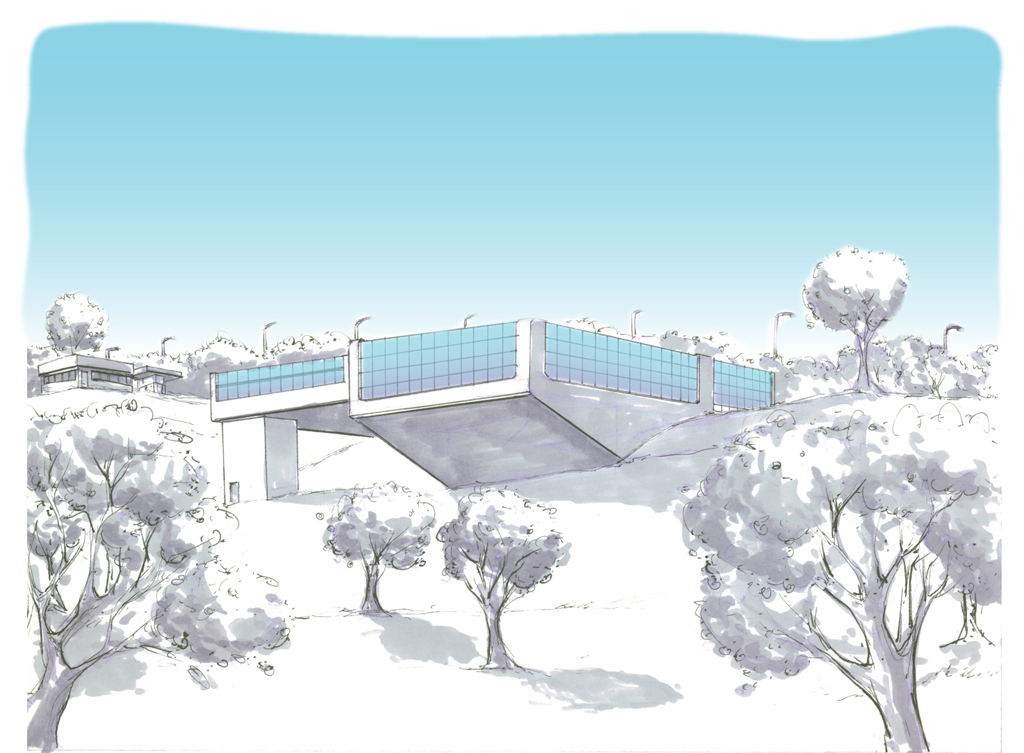
In the forest, some trees grew right up to the river bank. One had begun to grow across the river, which presented a precarious means of crossing over the waist-deep water. Some of the trees were over eight feet in diameter and presented multiple ways for someone to climb high up into their branches. This area was made even more excellent for “Fallout” by way of including the civic center in the game level. In the summer they would be able to designate both the pool building and the outdoor areas as the game space. The pods were connected by glass-walled catwalks. They could be exited at the base of their concrete support shafts. The mix of recreational facility and conservation area made for some hectic game situations. Teams would chase each other up and down stairwells and use the heavily forested sections to run and hide, or just camp out and wait for the timer to reset.
They sent SMS messages to both Eddy and Lucas, asking if they wanted to meet underneath the civic centre recreation pods. They replied a few minutes apart, Eddy saying he would make it within fifteen minutes and Lucas telling them he would take a while longer because he was waiting for his friend Kara. Eddy and Lucas were two kids from who attended the same elementary school as Charmaine and Tobias. They had all met in the computer media class where they learned about multimedia technologies and were
given research projects that allowed them to use their software skills to create short videos, games and virtual environments. Most of the software they used was beginner level, but as a group they had been able to excel and create sophisticated things that were beyond the objectives of the coursework. Virtual technologies were a pervasive aspect of the world in which they lived. “Zone Tactics” existed as the ecotone where thier different natural habitats could coincide and overlap.
At the start of a game of ‘Fallout’, each player would be assigned to a team and given a ‘Rad meter’. The ‘Rad meter’ was a virtual game
element that was like a health meter common to many types of video games. The Rad meter acted as a gauge for measuring the amount of imaginary radiation that a player was exposed to throughout the game. Any duration of time that a player spent in possession of their own isotope or that of the opposing team would contribute to their overall levels of ‘radiation exposure’. In this sense, an isotope was similar to a hot potato, it could only be carried for a set duration of time before the player carrying it was burned.
If a player’s Rad exposure was maxed-out, they would automatically drop whatever isotope component they had been carrying. They would then have to wait for the Rad meter to fall back to zero. They could radio for assistance, or just wait for the Rad meter to reach zero and then try to re-collect them. An isotope component‘s position was indicated on the GPS map with a specific icon. Different colours or bitmaps were used to represent the various team’s isotope components.
Much like Phyzzles, the isotopes were also virtual models. It was strategically advantageous for a team to collaborate on the design of their isotope model, including “keys’ or other cryptic elements in the construction to allow the isotope to be both put together and taken apart, according to a specific, formulaic outcome. A team might be able to successfully collect all of the opposing teams isotope components, only to find that there exists either a correct or incorrect syntax to it’s assembly. It made the ‘Fallout’ game scenario much more complex, and provided a way for the players to contribute their own inputs to the game to avoid having to use the same models and maps over and over again.
Almost every virtual game element in ‘Fallout’ could be customized. The only thing that remained static was the physical environment in which the game was situated. In alot of ways though, it wasn’t really static at all. The weather on a particular day could have an impact on whether they chose to play mostly indoors or outside, and the people that were present in a particular game area presented challenges in terms of avoidance. Lucas’ parents were known to drop him off for a play session, only to mysteriously reappear a few minutes later, having found some excuse to hang around and keep an eye on their games. This could be fun because ‘Fallout’ could have mini-games within it, sneaking around, trying to avoid giving away thier presence. Using text messages, they could coordinate their movements in silence, sometimes the game itself becoming like hide and seek, all movement performed on the cusp of detection and with an awareness that reads the wind for directions as to where they shouldn’t go. They became most intensely focused upon the fantasy, taking for granted that these devices presented only the basis for the bigger thing between themselves and the world to take place. The bigger thing–the world, is the territory of Zone Tactics.
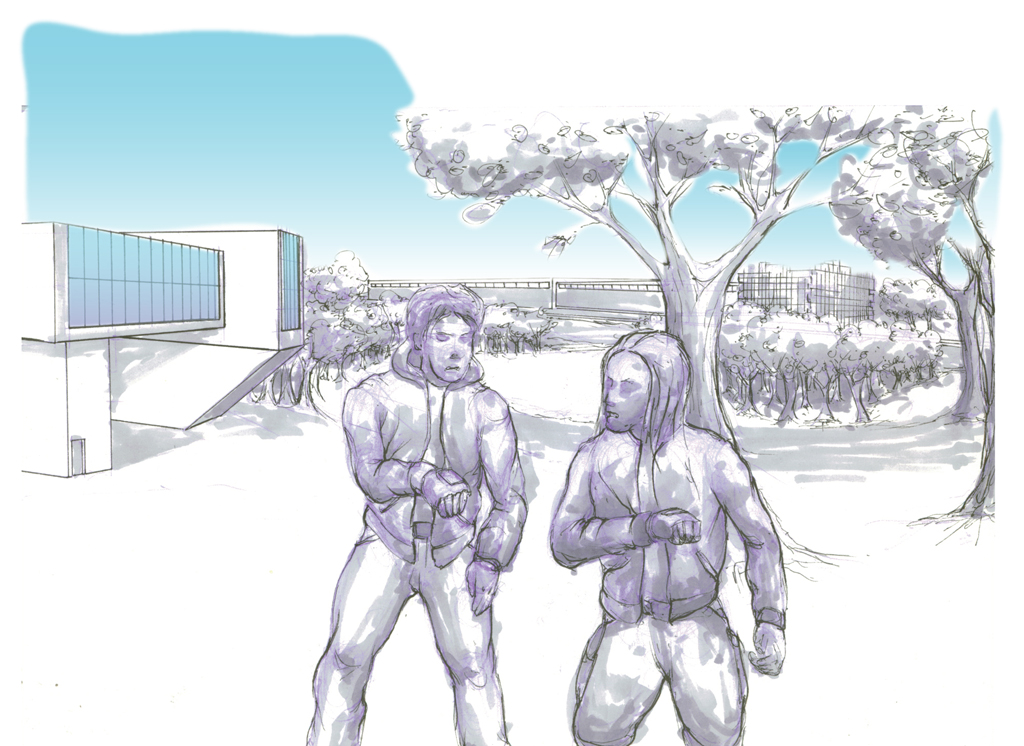
Eddy was in sight, his avatar placed him at about one hundred metres north of where Tobias had stopped and sat down, on a fat stump beneath one of the pods. It had begun disintegrating into a black and pungent mulch. Charmaine was opposite of him, standing with her back against the smooth, cool concrete of the support shaft. The pod was balanced high above, it’s steel super-structure visible from below, fused with the concrete to create a perfectly flat underside.
“Hi” Eddy said as he walked up, carrying his skate in one arm.
“Mister Eddy.” cut in Charmaine, imitating their math and science teacher. She did so because Eddy was something of prodigy. He had moved beyond an accelerated math program in grade 5 and had accumulated nearly all of his high school math credits. He wasn’t technically permitted to attend classes, but that didn’t stop him from writing the exams in closed-session. He had played instruments since he was a baby and was accomplished with the guitar. He also picked up some skateboarding just by the fact of where he lived, in a townhouse complex only a few streets away from the skatepark. Eddy wasn’t totally mad about console games, he found them to be arbitrarily cyclical. The pattern of any game could most often be learned early on and repeated throughout the progression of its levels. You usually wound up at the end without really having learned any new skills. When he got together with the others to play
Zone Tactics, it was a game that had a different quality, not necessarily better, just more interesting by virtue of the places they explored and discovered while playing it. They could fit Zone Tactics into other activities as well, like if they wanted to use bikes or skates to move around the environment. The interface wasn’t an encumberance to physically intensive game play. Rather, it was physically synchronous with their nascent athleticism.
The constraints imposed by distance often required a great deal of physical exertion on part of the player to complete the game objectives. Whether they walked, ran, biked or skated, they had to move fast. The game of Fallout was not one of effortless accretion of skill to the player, but rather one where the objectives were consistently uncertain, the information spotty. The only thing of which they could be fairly certain was their own location as well as that of their teammates. The degree of complexity they chose to program into the objectives was the product of their collective imagination’s owns limits of conception. If they couldn’t imagine themselves partaking in a game of Fallout in a particular situation, it was the case that they aborted the mission. This was most often not the case. The days of Fallout carried them overland. The games themselves could also be carried overland, far and wide, picking up weeks or years after having been put on pause. The next high score was always located closer to the horizon.
“What are we waiting for?” was first in the order of operations Eddy considered essential towards realizing the desired outcome of
the game beginning.
“We’re waiting for Lucas and Kara” replied Tobias, Charmaine at the same time focused intently upon on him as if he were some
inexplicable fixture of the designed landscape.
“Hey Charmaine.” he said to her, aware that his voice was but one of the multiple channels of information that she was capable of
perceiving at any given moment.
“Hi Eddy” she responded, a small smile slowly resolving in her cheeks, becoming at once apparent that a smile was in fact the facial expression that best suited her person. Kara and Lucas appeared at the edge of the hill, waving down to them from their mountain bikes. Kara popped up over the curve and dropped in with Lucas close behind. They dropped-in towards the trio that had gathered beneath the pod, sitting at the edge of the hill and cantilevered out over the wetlands spreading from the river. A band of checkered neon, pastel and grey had been painted around the base of each support shaft where they had accumulated graffiti since being constructed. Kara skidded to a halt but Lucas swerved around her, flying off the edge of a small mound used as a campfire pit.
He and his bike slammed down onto a slope that carried a few hundred feet towards to the marsh before stopping at a wall of
tangled brush, the first blades of summer grass rising above last year’s pale and deadend overgrowth. Reflective patches on his backpack caught the sun, the shapes suddenly flattening in their glittering neon brilliance. He braked late, the discs letting off a shriek of ceramic on steel that was faintly audible over the wind. The sun had tracked far enough across the sky that it was peeking under the side of the pod, one half harshly lit and warmer than the other, which stayed cool in the sun’s bluish shadow.
“Ok now, here we go..” said Eddy, though to no one person in particular. They looked over to Lucas, who was starting back up the hill when he climbed off the bike and started to push it ahead of himself.
“We just have to wait for Lucas.” explained Kara, knowing that they couldn’t just start without him. She and Lucas were the only kids in the group you could say were inseperable. They almost always played as a team and games could tend towards ending in stalemate when they were placed on opposing sides. They had been able to cover more ground and learn more secrets about the city than almost anyone else had collectively. Their mode of transportation made this knowledge necessary. Being that Newmarket was a city
that had been built to accomodate the automobile, the more cyclistfriendly areas were as such for the precise reason that cars hadn’t
yet been able to infiltrate these areas, the city’s best kept secrets.
“Ok, teams won’t be even.” observed Charmaine.
“How about Kara and Lucas are team one, the rest of us are team two?” suggested Tobias. “They have bikes so they can go further than anybody else.”
“That seems fair.” said Kara. She might have taken issue if they had tried to seperate her and Lucas. The odds of winning didn’t increase for them so much as even out. The trees and overburden from years of uninhibited growth had made certain critical paths in
the area unpassable, even with an off-road bike.
“We should synchronize our game data now.” Tobias had interjected as though it wasn’t already a matter of fact. Each of them had flipped to their respective team’s GPS tab to perform a check ensuring that thier feeds were synchronized, so that each player appeared to be located in the proper direction as indicated on-screen by the avatars. Where Kara and Lucas were standing beneath the pod, pulling protective gear out of backpacks, their avatars seemed to hover above the pods on-screen. This was again, as a result of the orthographic map not appearing in realtime. If a player crawled under a solid object such as a building, their location could still be approximated by range-measuring between Gizmondo units. It was only if someone went into a signalfree zone that they could be suspended from play. These out-of-boundary areas were visible on-screen as a semi-transparent pixellated distortion effect, similar in opacity to the lens-etchings used in range-finding binoculars or a film camera’s zoom-lens. Time penalty would occur if you stayed in one of these areas for too long. Your time remaining to locate and apprehend the opposing team’s isotope would be deducted from, reducing the likihood of your team returning to base with the objective intact. It was only if the isotope was fully assembled that it could be carried by any one individual player without increasing their Rad exposure rating. Even if you collected all of the isotope components, your Rad levels would continue to increase until the moment that the isotope fragments were combined properly.
It was often the case that the isotope required more than one person to piece it together. This usually meant that a team’s members would have to estimate the best meeting point for them to take the components they have captured and join them together. One team member can return it to base while any remaining team members can stay behind and capture the opposing team’s players. To take another team member out of play, you simply have to perform an Optic Capture on that person. The TacPac comes with a Signal Patch that uses a patterned LED, emitting light pulses in a unique configuration. This looks a bit like a flourescent barcode. It is displayed anywhere on the player’s body. It is the identifier unique to each TacPac, and is read by other Tac Pac/Gizmondo hybrids for the purposes of Optic Capture. It provides visual data that acts as a digital-optical representation of the player and assists the computer in the redrawing of the gameplay.
If a person is captured, they drop whatever isotope component they were carrying. This can then be picked up by the opposing
player, and taken farther afield to prevent it from being returned to the opposing team’s base. After about thirty seconds, the captured player is released. They can then go after the opposing player and use the same tactic to attempt to retrieve whatever isotope component they had been carrying.
“Fallout in five minutes and counting.” chimed in Charmaine, half-jokingly imitating the Zone Tactics synthesized computer voice.
The decks of each player sounded off simultanously, the computer voice initiating the start of the game:
“Five minutes to Fallout. Teams one and two have five minutes to reach minimum safe distance.”
It was then that Lucas’s TacPac screen zoomed out, climbing up to a virtual altitude of around two hundred metres. He could see his and Kara’s team one avatars as green triangles. There were three inverted triangles, painted red, that identified the players on team two. Leaning over the handlebars, he stomped down on the peddle while keeping the front brake clamped. The rear tire lifted up and started spinning in a puddle he had positioned the bike in front of. It sprayed out behind him as he let off the brake, lurching forward and accelerating towards a path through the tallest cattails. Kara saw his avatar change position on screen, he was now heading in the direction of their base. The location of the base was randomly selected from a number of locations specified by the players. They had played in this area several times before, so they knew of good places to hide out.
Once Lucas and Kara were within the boundary area of their base, they could pick up and move the various isotope components to different locations within it. They couldn’t take the isotope components away from the base otherwise the game would automatically return them to the correct area. Only the opposing team would have the ability to withdraw from the base carrying an isotope component. Even when they did, it was only wise to do so once your team had collected a number of components, if not all of them. They could be dropped anywhere within the game area and their exact locations were always available to the players on both teams. If you saw a player from either team through the scope of the TacPac, it would read their Signal Patch. If they had been carrying an
isotope component, that information would appear on-screen as a graphical icon, overlaid on top of them.
You could always find the location of someone from their avatar’s position on the screen, but you couldn’t always see them in real-life. They could appear to be standing right beside you on the game map, but so well hidden in the real world that no matter where you looked you couldn’t find them. The avatars began to overlap at ranges of less than ten metres. This was the threshold where trans-reality gameplay took effect–the edges of the electronic game reality blurring into horizon of the physical world. The locations specified as in-play by the Tac Pac presented their own anomalous glitches and mediated un-realities. There were, for instance, places
that had urban legends attached to them, thus they were never intruded upon. This included a section of train tracks just outside of town said to be haunted by the ghost of a man with the lower body of a goat, some sort of demonic trans-genetic urban legend that emerged from the collective imagination of the generations of people that lived there.
Fallout was distinguishable from other games for it’s tendency towards being genuinely stimulating to the imagination. When we stare into the darkness of a forest path in the daylight, we can’t help but feel a primal urgency to stand back from the shadowy void. We dare not turn our back on it when we imagine what could be there, waiting.
Within three minutes Kara and Lucas were inside their base. Kara put her foot down and dismounted. She turned around to look at Lucas, who was off his bike, kneeling beside a tree, using the TacPac to scope out the other team. They had been visible only a minute before in the tall grass beside a stream to the east. The lush and densely forested pocket where team two’s base was located was connected to the rest of the area by footpaths, so it would be easy for them to locate it and escape. The only problem was that the pathway leading towards it was exposed. With no way to conceal their approach, team one would have use speed as their means of getting close to the objective, then stash the bikes and take the back way in.
“Full speed or silent intrusion?” queried Lucas, not predisposed to either means of entering the objective area.
“I think that if they’re watching from the trees, they’ll see us as were moving in.” Kara pointed out, scanning the team one base area
on the TacPac. Three red inverted triangles could be seen, clustered nearly together. Eddy’s avatar separated from the group and headed off, not in the exact direction of the team one base but further to the south, as if he was intent on flanking their right perimeter.
“I think I should go alone, and you stay here to keep the isotopes from being captured.” Lucas’s suggested, intent on striking off alone into the opposing team’s territory, able to assess and act upon his own instincts without compunction. He had developed a technique of staying low to the ground, and sprinting in short bursts to the various isotope sites. He was uncannily good at outwitting his opponents, who often relied too heavily on the TacPac’s scope and capture functions to protect their isotopes.
He could run full-on towards an isotope component, then turn on a dime and capture a different one that wasn’t as well protected.He kept up his speed, which was calculated from displacement rates that were measured each second, to update the game info. If his speed dropped, the Gizmondo would begin vibrating at a preset frequency so as to alert him.
“That’s a good idea if there were less of them, but because Charmaine and Tobias are staying behind, it would be better if we both went.”
That decided it, they would work as a unit. When the players on a given team approached within close range of the isotope, the tracking data that helped them locate it would be distributed. This meant that each TacPac would then be receiving a specific component of the detection spectrum. They would corelate this information to locate the approximate GPS coordinate where they would have to be standing in order to capture the isotope component. In this particular instance, Kara would be receiving a feed from the audio spectrum. This would sound to her like a ping, similar to the sonar bleeps from old submarine war films. The ping was relayed in 3D stereo surround sound, so she could close her eyes and imagine the approximate source of the ping she heard through the earbuds. Lucas would have access to the visible spectrum. The only information afforded by the visual feed was directional. He would see an animated gyroscope model, placed on the upper-right of the Fallout game screen, and check it against Kara’s audio to locate the source.
They flew by the trees, skimming over puddles of muck and river silt. Infiltration was the second most intense period of the game. It meant leaving the isotopes behind, where they were beyond your control. It also meant going up against the opposing team, who could be hiding, waiting for you to expose yourself to the possibility of being optically captured. The most intense game period was when you had located all of the isotope fragments and brought them back to base. Having collected all the components meant that your team was one step away from winning; you still had to determine the correct assembly configuration of the captured isotope. When this was either solved or decrypted, the Gizmondo that contained the complete code of the captured isotope would transmit a confirmation signal to all the individual player’s Gizmondos, signalling the end of the game and identifying the winner.
They had stopped, looking beyond tall grass at the woods to the north.
“Lucas, we should put the bikes under that hedge.” whispered Kara, pointing to a dense and tangled mass of cedar and vines that provided enough vegetation to give the bikes an improvised disguise. They dismounted, rolling the bikes in and under the shadowy canopy which hung just above their heads.
“Okay Kara, it looks like they have a total of three parts. We can go in one after another. I’ll get the two- one by the river and the other on the path.” said Lucas, looking down at the TacPac where they could see one isotope model at the edge of the stream, another on an open patch just off the main path. the third resting in the middle of the woods, on the eastern edge of the game area. The third one would be tricky if both Tobias and Charmaine remained hiding in the woods.
“That means that we should meet up near the stream before we make our getaway.” surmised Kara, estimating the approximate point where they could dump all the components on either his or her Gizmondo. If they tried to return directly to their base without putting thier isotope fragments together, thier Rad exposure rating could climb to dangerously high levels. If it climbed too high, they would automatically drop any component they were carrying and if another player didn’t pick it up soon enough, it would evenually revert back to it’s original location. The effort made to locate and retrieve it would be wasted if they were to underestimate the time needed to intercept each other on the way back.
They moved up, Kara taking point with Lucas falling in line behind her. When they could see the stream, they paused to scan the distant woods for activity. Lucas stayed low before breaking out in a sprint, running full speed towards the stream and leaping through the air, crossing over it as it flowed by underneath, a swift and murky tributary fed by a pond to the east. He landed on the other side and scurried for a small bush out in the open, away from the stream. A second later, Kara did the same, though only after waiting for him to signal that the way was clear. As she landed, a warning alarm sounded off from Lucas’ TacPac, indicating that someone had locked onto him. As they heard the ‘optic capture‘ tone sound, the expression on Lucas’ face transformed into shock and disgust; he was the last player they expected to be captured, though his temporary hiding spot was clearly inadequate. Kara checked the screen and saw that Eddy had flanked them and was crouched on a grassy knoll only a few hundred feet to the south. It was from this improbable range that he had captured Lucas.
Lucas would be out of the game for thirty seconds. His TacPac would still indicate the base locations and display the game area, but he wouldn’t be able to see the locational info for any of the other players. Kara let out a quiet sigh, disappointed that Lucas had been so careless.
“Lucas, you head for the woods and wait near the edge. I’ll move towards the other components and when the capture wears off, you can use the two-way radio to help me find their exact locations. When I have them, I’ll head back and meet up with you. We’ll get the last one together.”
She ran towards what sounded to her as the source of the ping. It’s bleeps started to increase in their frequency, meaning that she was getting closer to the location of one of the isotope components displayed on the TacPac. After thirty seconds, she heard Lucas’ voice crackle in her earbuds.
“Kara, I’m facing north. I have the first part located at north by fourty five degrees west.” he came in, giving her the precise direction in which she would have to travel to reach it. She stopped and flipped to the GPS tab of the game screen, getting into a crouch and creeping forward in the direction he had given her. She could hear the pulses quicken, the screen showing her avatar superimposed over the isotope model.
“Okay Kara, now move to your left and you’ve got it!” he came in, content in knowing he could still affect the retrieval even after having been put on time-out . She stopped and turned, crawling now through the tall grass in order to maintain a low profile.
The ping’s frequency had gradually increased as she crawled forward, until the point that it bled into a perfect continuum, a rolling wave like a Theremin, filling her ears.
“I think I have it.” she hissed, looking down to the TacPac and seeing the confirmation screen: “Isotope retrieval confirmed” scrolling across the screen in an angular andromedan font, a gradient wake of anti-aliasing pixellation trailing behind the text message’s amber-onblack radiance. She sprang to her feet and broke away from the edge of the stream, now headed in the direction of the second component.
She was running now, across the open field now only slighlty green, interspersed with tough nubs of boulders and brush. She took a couple of minutes along the path and after having found the second component, it was becoming obvious that the bike advantage had worn off. It could be seen from his avatar that Eddy was making good time, getting two of three of team One’s isotope fragments before making a dash for the third, hidden deep inside the forest. By the time Kara and Lucas made it back to their bikes, Eddy might already be on his way back to home base. They would have to try and intercept him.
Tobias was up on the berm, crouched low in the grass with his camoflague hood pulled up over his head. The berm was an ideal spot from which to scope out the entire play area. He had been directing Eddy’s moves from afar, using his directional gyro to fine-tune Eddy’s audio ping.
Charmaine had been patrolling the interior of the woods where their third isotope component had been planted. She darted from tree to tree, circling around the massive, rotted trunks of ones that had been struck by lightning. The giant among them had been split open, sunlight pouring into it’s core, which hadn’t been exposed to light since at least the middle ages. It smelled of a mouldy funkiness, the red bark disintegrating into slivers and then into a fine mash, blending into the ground around it, which was dusted a pale grey. This had been the residue of the spring melt, when the river would overflow it’s banks and deposit a fine silt upon everything in it’s path. She crept over a collection of river debris, branches, plastic bags and ancient styrofoam fast-food containers that had accumulated from decades of seasonal flux.
Snap!
She heard something crack underfoot out near the tree line, someone was creeping up, though she couldn’t tell who. She looked at the TacPac to see that the avatars of Kara and Lucas were nearly on top of her. They had infiltrated the perimeter of the base in the space of about two minutes, very likely intent upon acquiring the last isotope component. Her TacPac emitted a warning alarm, low and urgent in her earbuds, providing her with the necessary stimulus to drop low and scan the treeline with her scope. The warning alarm stopped after a moment, her concealment adequate for the time being. She hissed into the two-way radio:
“Tobias! Kara and Lucas are inside the base! They’re going after the last piece!”
He came back: “They won’t make it back in time before Eddy reaches us. He collected all three of their isotope parts. See if you can get out of the woods and meet up with Eddy half-way. His Rad exposure is pretty high and he doesn’t think he can make it all the way back.”
This was inadvisable, she thought, because for her to escape from the woods, she would have to go directly past Lucas and Kara, who were now less than a hundred feet in front of her. Turning this task back over to Tobias would be the more strategically viable option.
“You’re already up on the mound, you go. If I try to make a break, one of them will probably capture me, then they’ll get the last part for sure!”
This incensed Tobias, who was more than content to stay up on his safe little patch of virtual real-estate and satisfy his scope-function fetish.
“It’s too friggin far Charmaine. What is your malfunction? Just go and get Eddy!”
She knew it would be pointless to try to convince him. He could be so not there sometimes, like he was reading his response off a screen, not really thinking about what was happening in the game. She raised herself just above the silty earth to a crouching stance, ready to make a run for a clearing at the farthest edge of the woods, towards the southwest. She could put some space between herself and team one, meet up with Eddy and carry the payload the last hundred feet. Then they would only have to solve it, which was her specialty.
She uncoiled like a sprinter, bounding over the impacted soil, hard-packed from frequent rainfall and flooding, zig-zagging through the thick of immature trees and debris that formed a web of obstacles snapping under her feet as she plowed through them. Her warning alarm sounded for an instant before she heard the dreaded click. Her pace slowed to a crawl as she came to grips with the situation. “I’m out Tobias. They captured me.” she mumbled over the two-way, conveying a sense of ‘I told you so’ through her tone of voice.
He crackled back:
“Get on the radio with Eddy. See if—.” She flipped the tuner over to Eddy’s channel, not bothering to listen to the rest of Tobia’s improvised plan of action.
“Eddy, I’ve been captured, but if we pick out a spot, we can meet up by the time it wears off.”
“Yeah, good idea. You see that tree, on my side of the stream, it has a big section thats all dead? Meet me there.”
Charmaine picked it out in a second, one hemisphere of it’s plume had small blossoms, just starting to bloom, while the other half was either diseased or had been struck by lightning. Standing up, she looked to her left to see the top of Lucas’ head over the grass as he ran into the woods. He had been waiting for her to go first, a classic take on the game of cat-and-mouse. She continued on towards the tree, catching a glimpse of Eddy as he pushed through the grass towards the drop-point.
“Kara, I’m in the woods. Use your audio feed to guide me to the last component. When I have it, I’ll meet you back at the bikes” Lucas crackled in her earbuds. He had moved into the thick of the woods with the intention of making a mad-dash back to home base.
“Turn about fourty-five degrees to your right.” She came back, providing the navigation to fill in for his clumsy directional gyro.
“Okay Lucas, you’re getting warmer– warmer…Stop! The tone is constant. You must be on top of it.”
“I have it Kara. We have thier isotope!” came Lucas, giddy and perhaps louder over the two-way than he should have been, given that
he was still located inside of base two, and Tobias was lurking near the edge of the perimeter. Kara looked to her TacPac to see Tobias’ avatar. He was circling the edge of the base, preparing to capture Lucas before he could make it back out with his payload. She crept through the grass, keeping herself small as she hid beside a pile of fallen branches. The pale and deadend grass draped over it like paper mache, creating the perfect concealment. At that moment she saw Eddy sneaking up on Lucas, his camo-hood making him hard to see as he crept along the edge of the woods. Kara switched the TacPac to it’s capture function and took a deep breath, zooming in on Tobias. He heard the warning buzzer sound but reacted too slowly. She tapped the trigger, putting him out. Tobias cursed as Lucas blasted through the wall of green, laughing as he ran past.
“Maybe try taking your eyes off the screen now and then Toby.”
Lucas shouted as he ran past Tobias, mocking his fixation on display technologies. Tobias glared at Charmaine for a moment, then turned tail and disappeared back into the woods. Kara and Lucas were now running at full-tilt, heading towards the hedges where they had hidden their bikes. Lucas could see on-screen that Charmaine and Eddy were now together, moving across the the open field in the direction of team one’s base.
“Should we give them a hard time? asked Lucas of Kara, not completely sure that it would prove a good strategy for their end-game.
”Lets just get back to base and solve their isotope.” She came back. They ducked under the hedges and mounted their bikes, pulling
their helmets on without bothering to close the snaps. They whizzed past trees, narrowly avoiding crashing as they hit a hard right nearing the stream. They plowed it, parting it for an instant like a biblical Moses in miniature, at a point where the maintenance crew’s truck had driven through it several times, leaving deep tire tracks in the dark and fertile earth. They would be inside their base in less than half a minute now, one last stretch over open ground before they reached the perimeter.
Eddy had dumped his catch onto Charmaine’s Tac Pac the moment that he reached her. They had only to lock-on to one another to establish an uplink. Eddy let out a sigh of relief when he heard the tone of the isotope transfer being confirmed. His Rad exposure limit was maxed out, less than a sliver of neon green was still visible against a crimson band along the edge of the screen. He had come very close to losing it, so he overran his mark, leaving the two of them with less than a hundred yards to go.
“Lets get going!” Charmaine exclaimed, taking off ahead of Eddy.
“Eddy the Yeti, what are you waiting for?” she called back to him, but he was frozen where he stood. He was looking beyond her to the main trail leading back into base one. She spun around and dropped onto her belly, instantly recognizing the sound of tires, ripping up the soil as they zipped along the trail. She turned her head to see that Eddy had done the same. He was grinning maniacally over at her, nodding his cue as Kara and Lucas sped by. Charmaine pushed up off the ground and took aim at the back of Lucas, hearing him let out a yelp of panic as he realized he was about to be captured. She tapped the trigger, returning the favour and in the same serendipitous moment, causing him to drop the isotope he had captured from inside their base. They scrambled to their feet and bolted towards the woods, laughing like the the ‘Frosted Lucky Charms’ leperchaun as they escaped to the safety of the trees.
Lucas skidded to a halt, yelling ahead to Kara as she sped on.
“Kara! I’m captured, I dropped the isotope. We have to go back and get it.” Hearing this, she braked, spinning her tail-end around. She rode back to where he had stopped and put her bike down.
Charmaine and Eddy pushed through the wall of branches which stood as the approximate line of demarcation between the neutral zone and their base. They saw Tobias, seated comfortably on a fallen tree. He looked up from the TacPac and flashed a smile, complementing Charmaine.
“Wicked good Charmaine. Flash and Turbo are still trying to pick up that isotope they dropped.”
“I was just returning the favour. I don’t know why they always want to ride their bikes. It just slows them down.” she critiqued. She
saw their avatars and realized she had spoken too soon. Now that they were moving, it was clear just how fast they go. The animations
of their avatars had started to lag behind their actual movement. The refresh was staggered, appearing once every few seconds instead of continuous, like someone travelling on foot. Eddy and Tobias crowded around her screen as she expanded the isotope model, examining all of it’s parts at once. They began to provide suggestions to her as to how she could assemble it. There was a rotating core, coloured a deep cadmium orange, with capsule-shaped slots along it’s length. The other two components consisted of bright blue semi-transparent casings. These appeared to have capsule-shaped bolts embedded lengthwise, very likely lining up with the slots cut into the sides of the core. In that instant, Charmaine understood how to piece it together.
She spun the palm gyro around, rotating the components around on-screen so they were aligned in the same plane. She grabbed at the air, highlighting one half of the casing and snapping into place. She did the same for the other, the blue shells forming into one with the core spinning at the perfect center. She zoomed in on the model, bringing the bolts into view.
“Okay now, the two of you have to activate the bolts at the same time. Tobias takes the one on the left, Eddy gets the one on the right.”
Charmaine instructed to the other two. They had each zoomed into their own views now, concentrating on the rotation of the core and waiting for Charmaine to give them the go-ahead. The core flipped around and around as they got a feel for it’s rate of rotation, nearly two revolutions per second. It was fast, but not as fast as the Class-A Phyzzles Charmaine was more than adept at piecing together under the constancy of gravitational acceleration.
“Now, on my mark…”
Charmaine’s fingers trembled as she watched the core flip over and over. She slid her index finger over the trigger and took
a breath. “One, Two, and…”
“Snap!”
They clicked their triggers with perfect synchronicity, the bolts snapping smoothly into the core and locking it in place. A shockwave passed through the model as it turned from transparent to opaque. It shuddered for an instant before an elaborate locking mechanism came into view, surfacing as if from a pool of mercury. the cap of it looking like machined ceramic, aglow with the various international symbols used for designating radioactive elements. It came apart, the four quadrants of the cap slidng outwards like a camera shutter. A long and narrow chrome cylinder emerged from the casing.
A crack of laser light split it open from the inside out, it’s outer shell falling away like broken glass as the glowing fissile core became exposed. The andromedan font scrolled across the screen of Charmaine’s TacPac:
“Isotope identity confirmed. team two wins.”
They met up with Lucas and Kara a while later, at the entrance to the conservation area. Their faces were splattered with mud, their shoes clad in swamp muck. Lucas dropped back and then moved in along-side Charmaine.
“Good game Charmaine. I totally didn’t see that coming.”
“Thanks dude. Good game for sure. I saw you on the TacPac, I mean, you and Kara were going pretty fast.” she offered, warming to the complement and offering something in return.
“It was pretty close. We had your isotope together, like the second after you guys had ours. Maybe next time.” replied Lucas,
the ‘maybe’, meant to be understood as ‘certainly’.
“Lucas?”
“Yeah?”
“I do you play Phyzzles?”
“I haven’t much really, but they’re pretty cool.”
“I found something in one of the Phyzzles you might find interesting,”
proposed value
target customer – pre-teens to early teens (nine to thirteen). Focus on groups with high potential for exploratory and active play. This would include skateboard and BMX markets. Developing the system to function as a pervasive MUD places it in a similar league to Gizmondo games making use of location-based technologies. The concept will provide these active youth segments with an outlet for an intensive, range-specific game. This can be described in essence as a hybrid of virtual fantasy elements making up the audio-visual element, and a story or structure that places these fantasy elements in the physical environment.
their needs – proprioceptive perception in pre-adolescents is developed through physical movement, most ideally through play. This is essential to the development of the brain (the cortical mantle specifically) and the child’s capacity for cognition.
Relationships are formed and strengthened through face to face contact. The natural social structures of people arise through proximity. The social structures that arise in the context of vitual games do not allow for this to occur with the same intensity. They allow for the articulation of identity, but non-verbal communication and complex body language cannot be exchanged as easily across the physical disconnect of a cyberspace MUD.
Habituation, defined as behaviors arising from familiarity and a sense of belonging to a place. The relation of the child to the place in which he or she lives has it’s basis in the physical connections the child makes with a place. The more frequent the occurance of play that engages the child with his or her environment, the stronger a sense of habituation that the child develops.
Identity – The concept is identified as “ Zone Tactics ”. It is a type of video game which is based on the idea of a “Pervasive Game” or one that can be played in a greater variety of locations than conventional console and computer-based games. “Zone Tactics” is inspired by the zoned-industrial neighbourhoods which present low interest to children for free-play activities in the outdoors.
Category (product/service category) – “Zone Tactics” is an interactive software game classed as location-based, GPS integrated. The game software would be developed for a wearable device using motion-sensing and gesture to affect the game-state of any game software developed for use with the platform.
understanding (interactive) media
If a video game allows you to perceive and interact with a simulated reality, and further allows you activate experiences that would be otherwise impossible in the real world, you have experienced an event of a transcendental nature. (Though not at liberty to disclose the specific identity of a medical doctor with whom I have been in contact in the past, he has shared with me an experience in his practice in which he observed the use of a video game as a means to trancend physical deformation; the game allowed the child patient to engage with some small modicum of control in his life, when there was so much that was beyond his control in reality.)
If video games and the dislocated social interactions they engender qualify as transcendental experiences, (persons playing with each other but physically apart) I termed my questions to capture the potential expression of these experiences in their responses. Benefit would arise in both the virtual and actual, I wanted to determine in what ways they could be complementary to one another.
Value – A richer internal life is reflected in the child’s familiarity with with his or her play space. The greater the complexity and variety of exposures to the play space, there would result in a more complex and dynamic internal reality (imaginary life) for the child.
Positioning of that Value – A game which allows for the positive attibutes of virtual games (intensity of fantasy) to act as the source of inspiration for play activities in physical reality. The challenge of the game translated into forms of physical play that enable children to develop in ways otherwise restricted within the framework of conventional game interfaces.
Unlike (Primary competitive alternative) – Nintendo DS, Nintendo Advance, Sony PSP. These handheld consoles are all differentiated from Gizmondo by thier lack of GPS functionality. Though not all are similar in terms of performance attributes, “Zone Tactics” advances the idea of the physical play space as being a greater source of fantasy and relevance to the target audience than that which is offered by existing mobile and handheld game systems.
the zone game – hardware design visualization
The following schema were developed in parallel with the preceding storyboards. This exercise gives an impression of the user interactions, as well as providing an aid towards the refinement of the user interface. These storyboards were and remain a work in production, with an additional sequences which were included in video versions shown in the Industrial Design 2006 thesis project exhibition. The storyboards were loosely based on the Zone Tactics user story. They begin with Tobias and Charmaine engaged in a game of Phyzzles, while a number of images in the following set provide a design visualization for the hardware interface Fallout
game concept. This preceding set of storyboards ends at the start of the Fallout game.
As support for the storyboards, virtual 3D elements such as the Phyzzles animation and Fallout GUI were developed and executed as both Rhino 3D models and 3DS Max animations, later woven into a short film which was projected within the exhibition space.
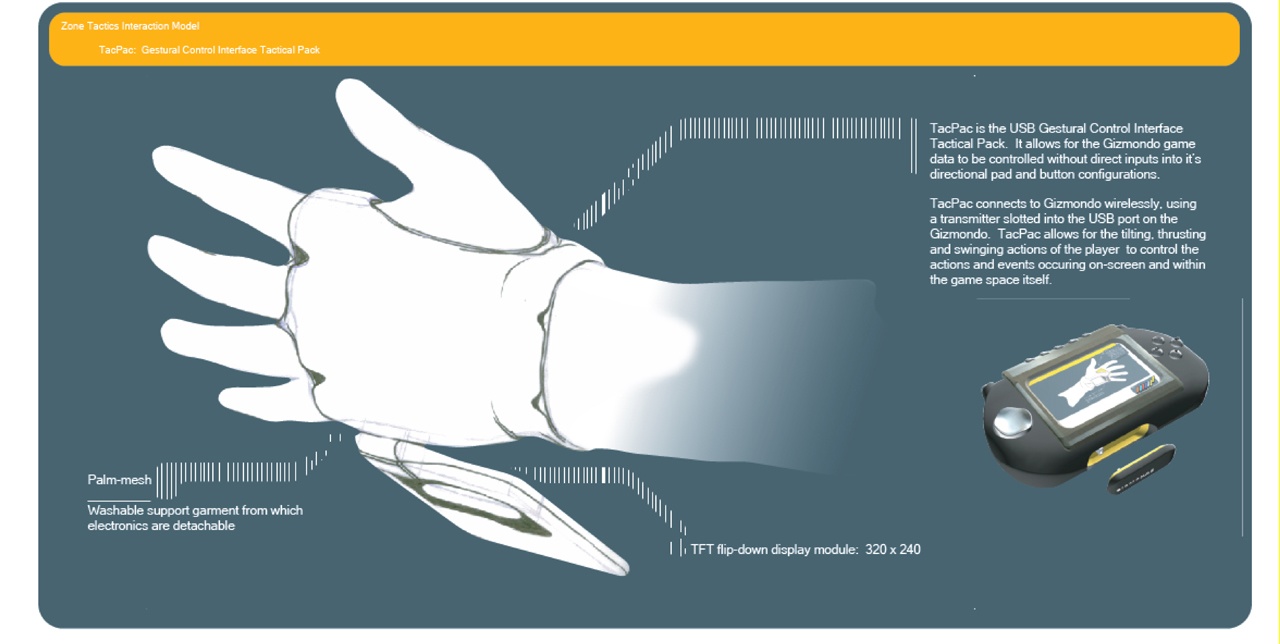
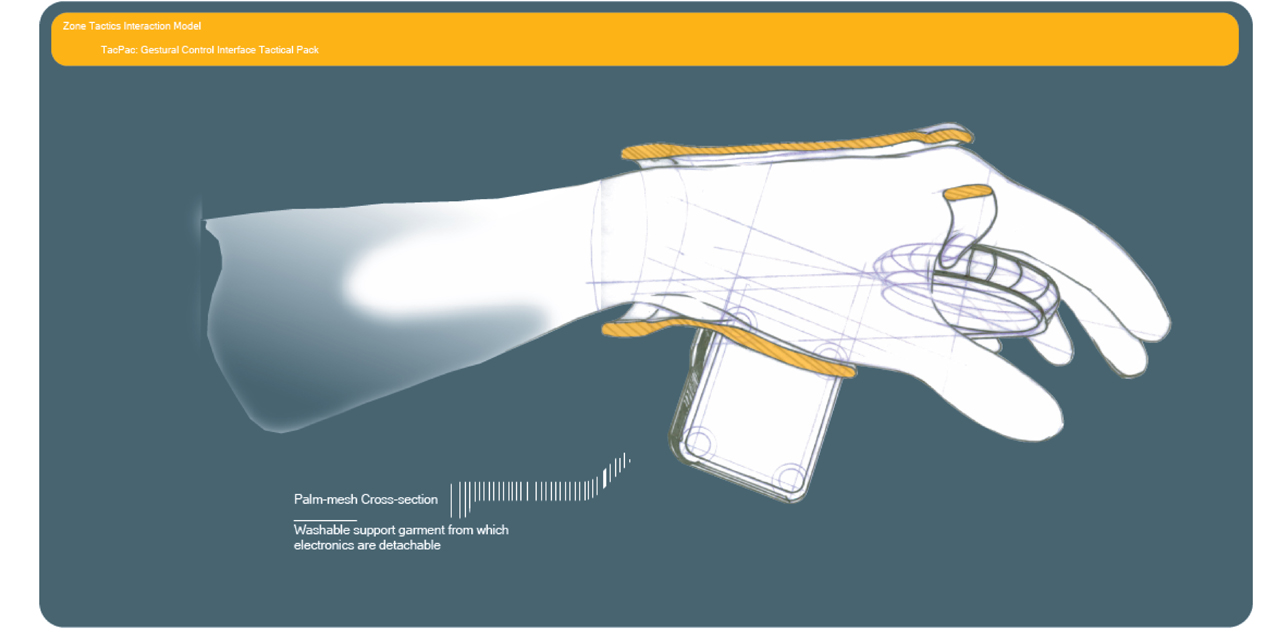
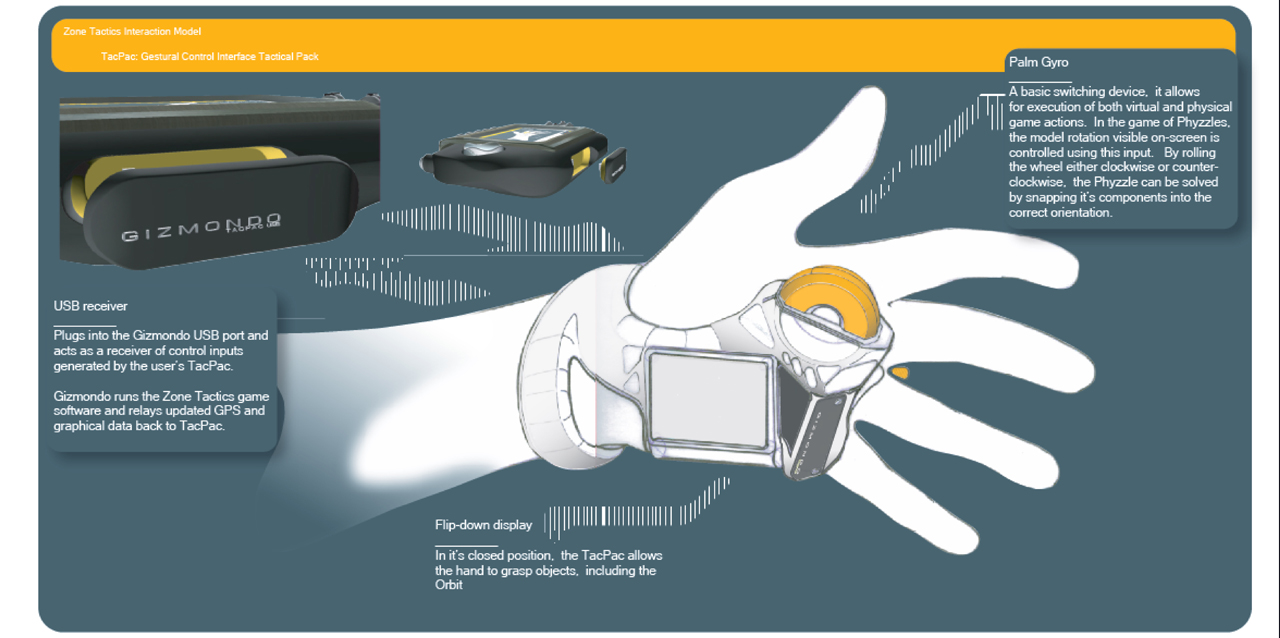
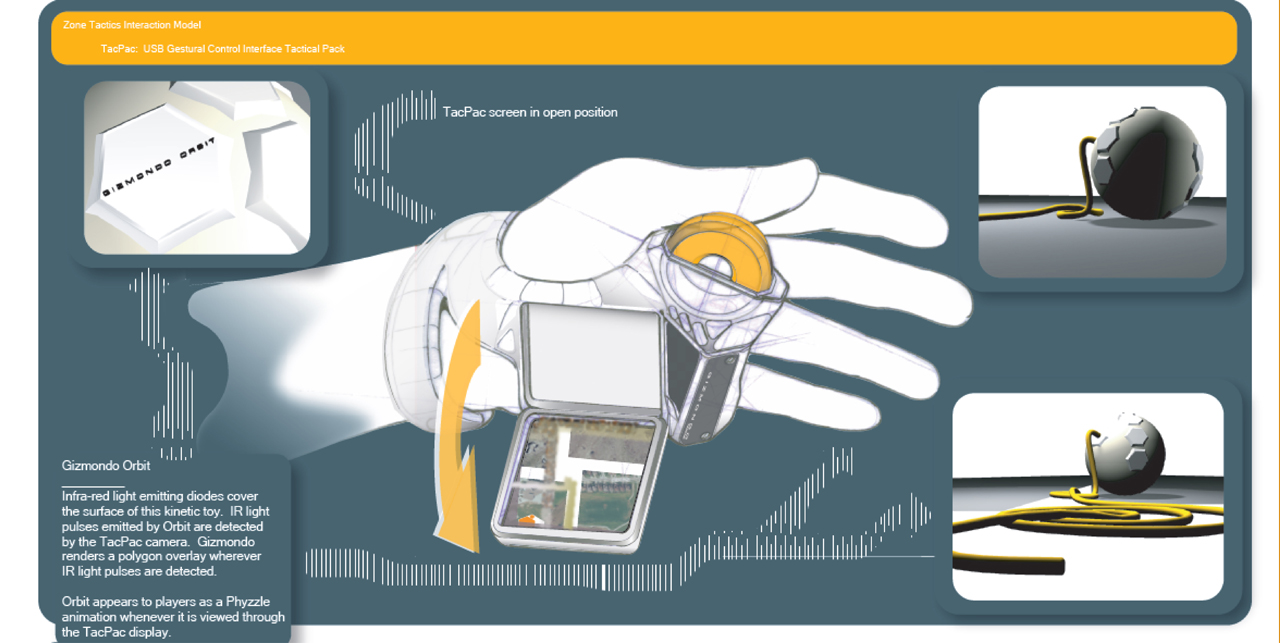
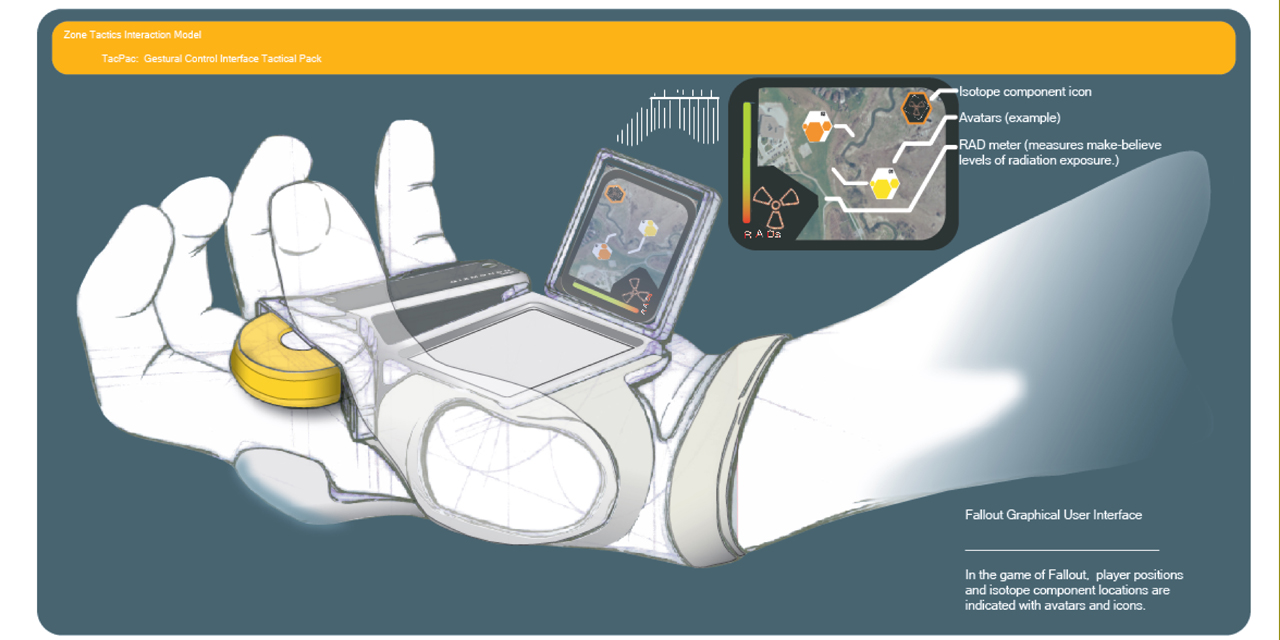
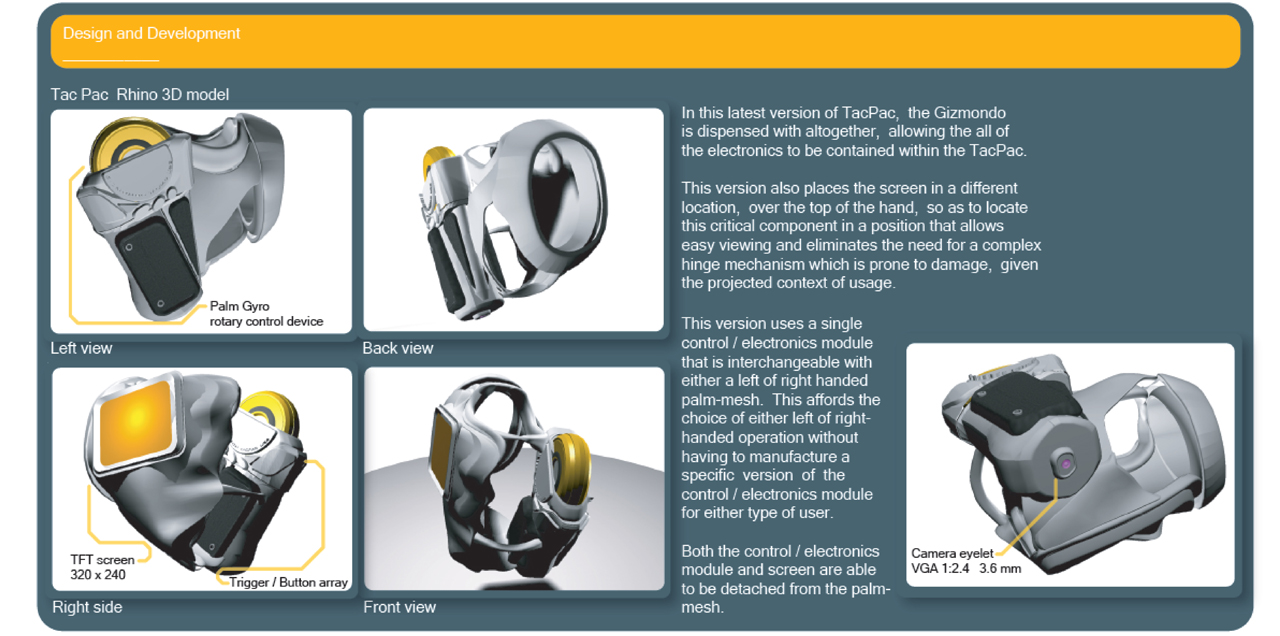
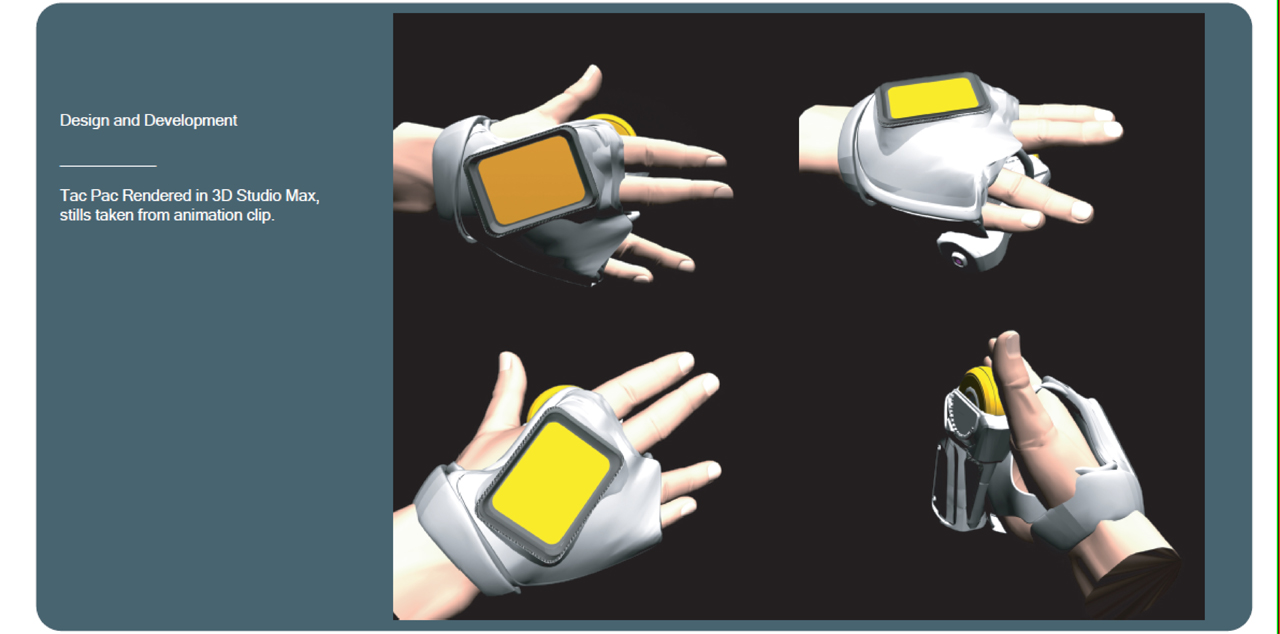
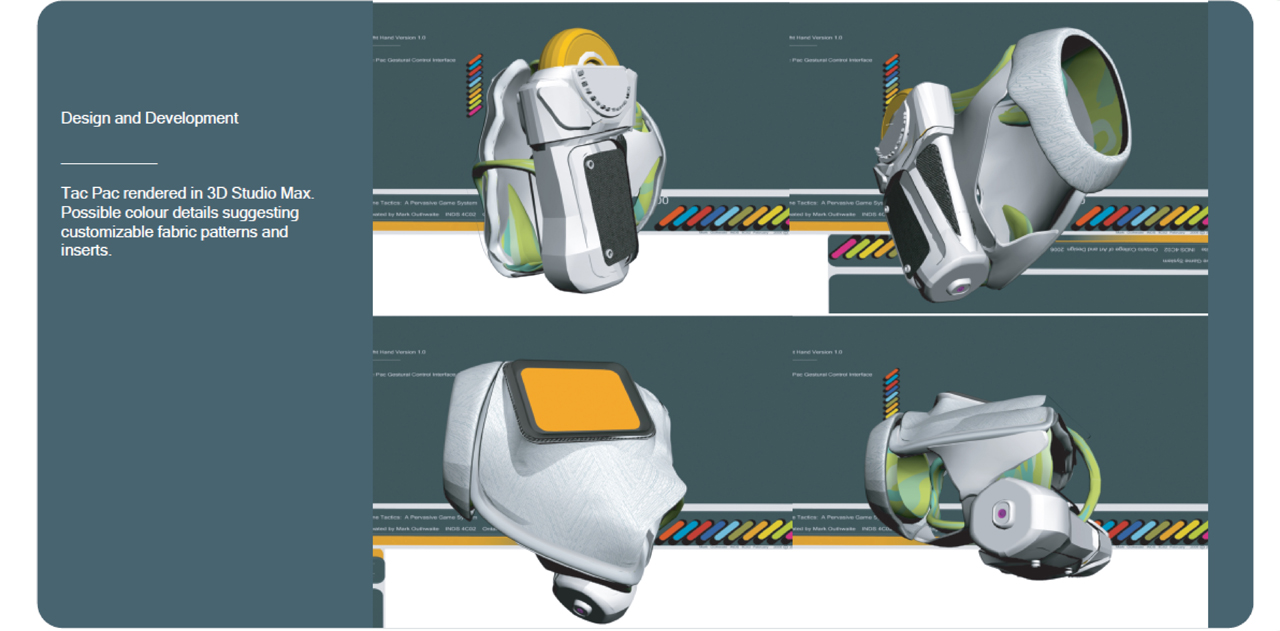
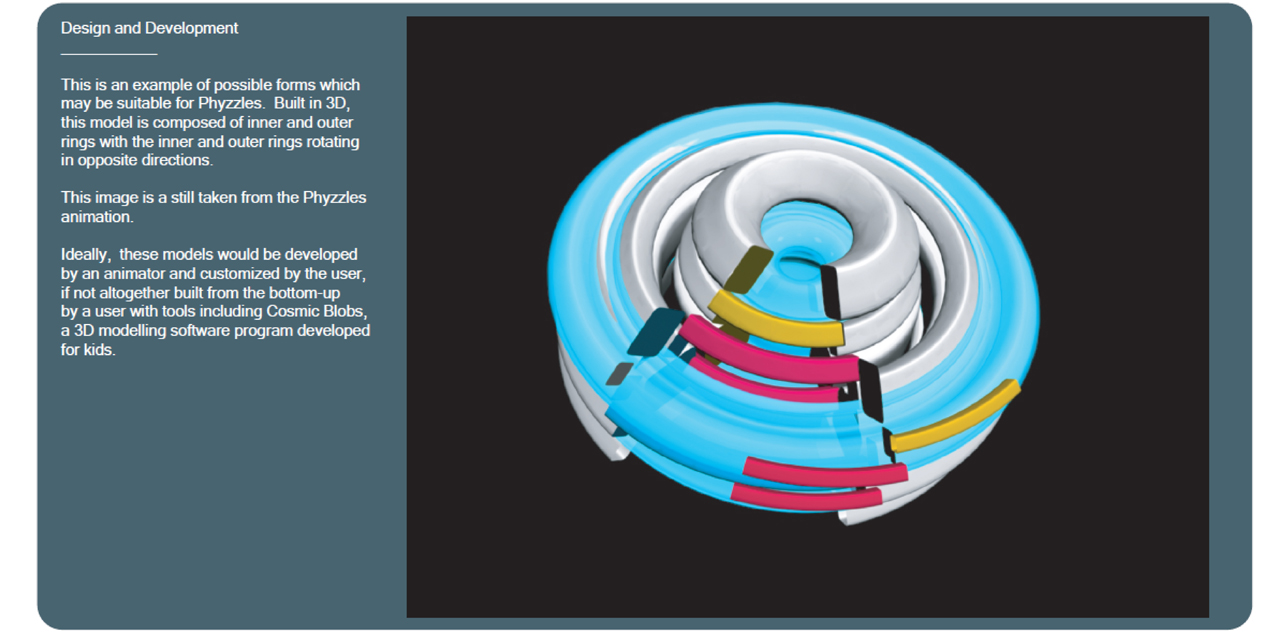
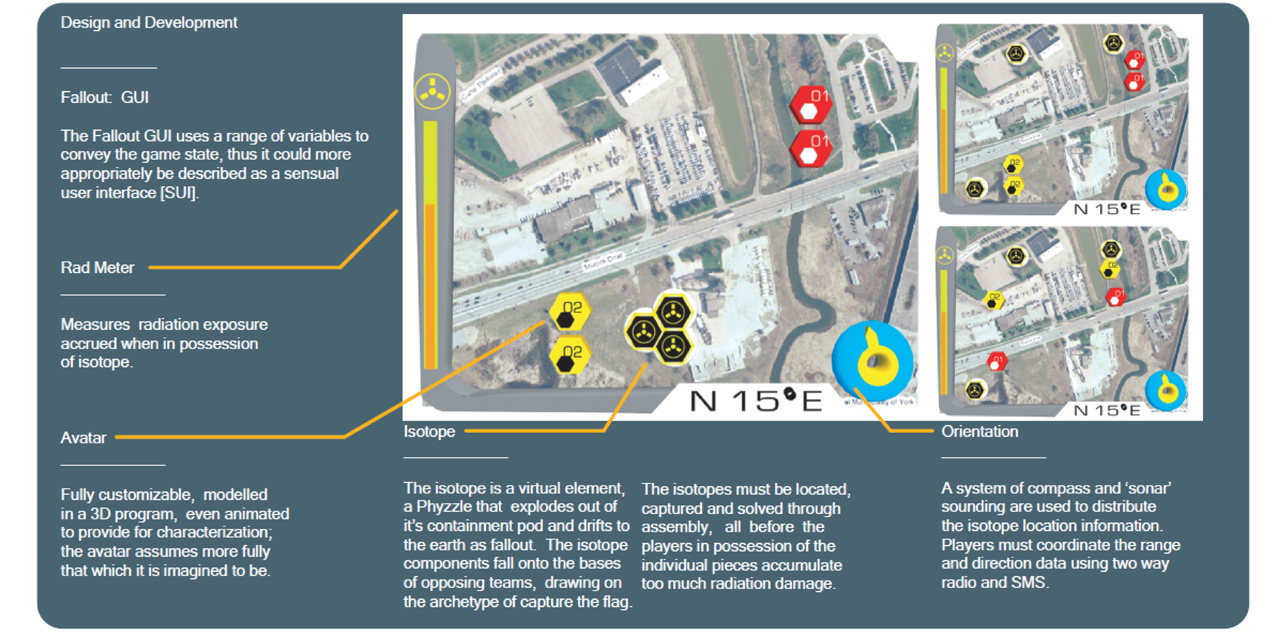



 tron carpenter