
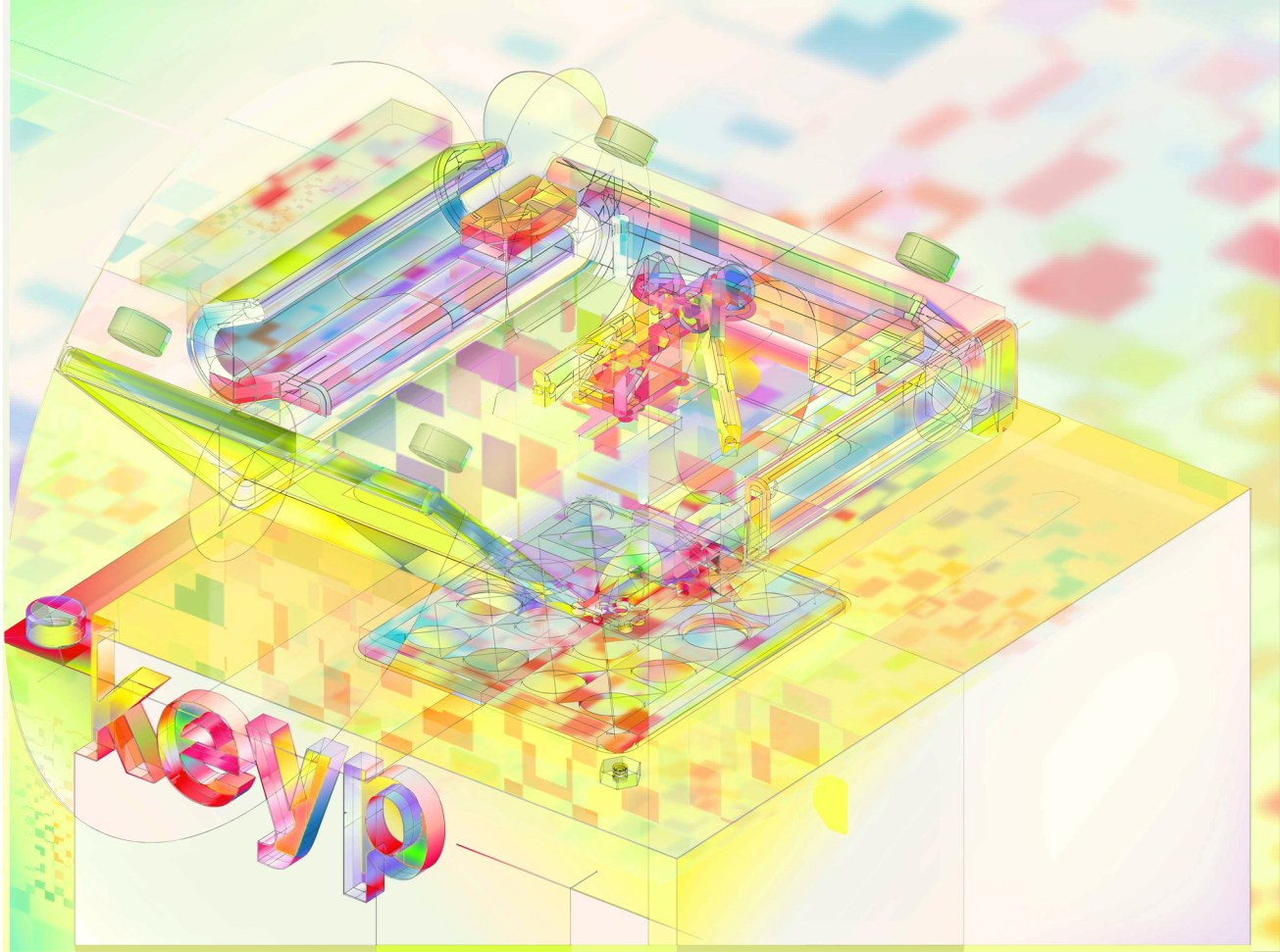
This painting, developed using a CAD file and illustrator software to colour each facet of a simulated product assembly, was inspired through mental sketches of prospective interactive objects. It is a wallet-size carrier of keys but the hypothesis of the product is that its communications, sensing and mapping facilities confer security, as in the case of emergency provisions one might have long ago stored in an area deep inside of a castle designated as the keep.
Substrate-independent ambient goods are a suggestion of an everted cyberspace containing the fluid dynamism of nature in synthetic systems, which is to say software whose artifactual output involves a kind of perceptual illusion of non-mediation, as in a viewfinder with film cartridges featuring details just visible at the minimum threshold of detection. William Gibson has described the emotional impetus of such technology in Zero History through augmented reality apps created by the storyworld’s inhabitants, geo-hacking an invisible and purely electromagnetic substrate of reality containing signifiers of eulogy to deceased actors and fallen soldiers. I’ve imagined interaction with this stuff would be like picking up a potato or similarly ‘dumb’ object with the expectation its embedded microprocessing would reveal adaptations for contained utilities as well as combinatorial signifiers of ways in which the artifact could be paired with other objects or systems to behave as mutual force-multipliers. The fiction of such things is the subject matter for a painting in this case but the fictions contained in all things partially produce the environments in which tool-making and artifact creation develop and evolve. The fiction in software is that it can be used to simulate or supplant most things useful to people as in a Kurzweillian universe of computational totalism, but it doesn’t and cannot. Language enabled software, as well as other systems and environments wherein with time and growth it became advantageous to develop software languages to control and influence these increasingly complex systems and environments. Substrate-independence, or specifically cognitive environments wholly independent of the human embodiments of physical interfaces and architecture is a techno-utopian orientation lacking symmetry with inexorable reality. As a notion of human mental conception its fiction bears a canny resemblence to painting, or similar activity of fielding perceptual and emotional influence in an observer. As a creator I prefer technology which is operable in the manner of the latter, the heavy and enduring facticity of matter given, taken and lost, matter wandering through time forever.

 tron carpenter